
For some families, the path to parenthood requires both an egg donor and a surrogate. These are always two different people — the egg donor is not the surrogate, and the surrogate is not an egg donor.
The egg donor provides the genetic material. The gestational surrogate carries the pregnancy. In surrogacy with a donor egg, these roles are always separate — the surrogate has no genetic connection to the child.
This path involves multiple moving pieces – medical, legal, and emotional – that often run simultaneously.

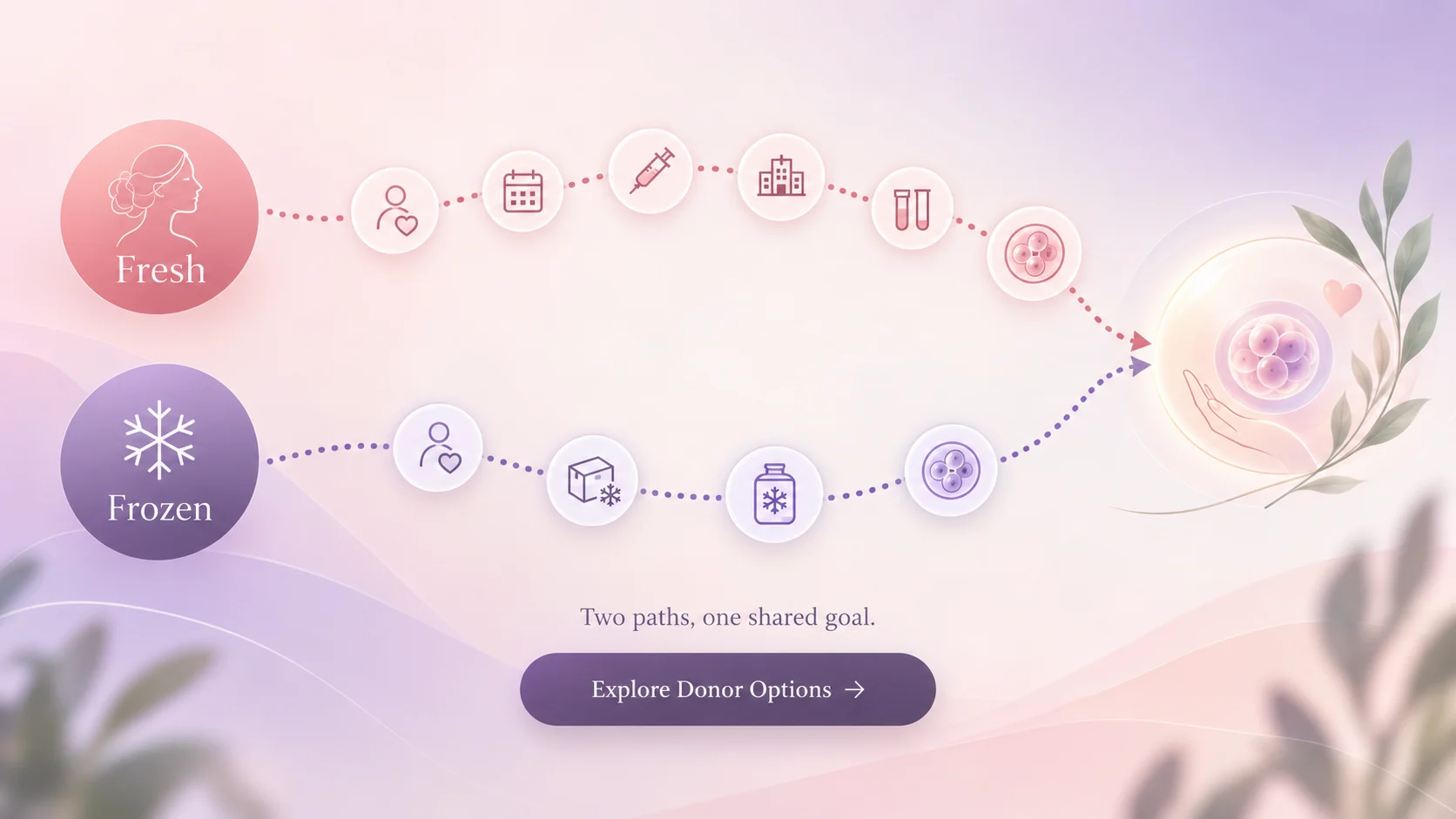
One of the biggest advantages of frozen donor eggs is that intended parents can complete some of the most important early steps immediately, without waiting months for a fresh donor cycle.
This guide explains how egg donation and surrogacy work together, what the step-by-step process involves, what the timeline realistically looks like, and what everything costs.
Key Takeaways
- • The egg donor provides the genetics. The gestational surrogate carries the pregnancy. They are always two different people in modern gestational surrogacy.
- • Frozen donor eggs eliminate the need to coordinate a fresh donor retrieval cycle – embryo creation can begin immediately.
- • While other programs take 15–18 months just to reach the pregnancy point, intended parents using Lucina’s guaranteed programs reach this milestone in an average of 3 months.
- • Creating embryos early – while surrogate matching and screening continue in parallel – is the most effective way to reduce avoidable delays.
- • The separation between egg donor and surrogate simplifies parental rights establishment for all family types.
- • Starting surrogacy matching simultaneously with donor selection can compress the timeline by weeks or months – embryos are ready the moment a surrogate is cleared.
The Difference Between an Egg Donor and a Gestational Surrogate
An egg donor provides the eggs used to create embryos through IVF. A gestational surrogate carries the pregnancy after an embryo transfer takes place.
In modern gestational surrogacy, the surrogate does not use her own eggs and has no genetic relationship to the baby.
This distinction is medically standard and legally important – it clearly separates genetic contribution from pregnancy carrying, which simplifies parental rights establishment for all family types.
The embryo may be created using donor eggs and intended father sperm, donor eggs and donor sperm, or donor eggs fertilized separately using sperm from each partner in a same-sex male couple.
Some intended parents also use preimplantation genetic testing (PGT-A) before transfer to screen embryos for chromosomal abnormalities.
Whether that step is right for your situation is a conversation for your reproductive endocrinologist – what the research shows about PGT-A in donor egg cycles covers the evidence in detail.
Who Needs Both an Egg Donor and a Surrogate?
Not everyone pursuing egg donation also requires a surrogate. For these groups, both are essential.
Gay Male Couples and Single Fathers
Donor eggs and a gestational carrier are the path, not an option. Many fertility clinics fertilize donor eggs separately with each partner’s sperm, and PGT-A testing identifies which embryos came from which partner, giving both the possibility of a biological connection to their child.
Heterosexual Couples with Two Barriers
Some couples need both a donor and a surrogate because egg quality is diminished, pregnancy poses significant medical risk, or prior hysterectomy or uterine conditions prevent carrying safely.
Cancer Survivors
Treatment can affect both ovarian function and the ability to carry safely. Donor eggs address the first barrier; a gestational surrogate addresses the second.
International Intended Parents
The US offers FDA-screened donor eggs and an established legal framework for surrogacy. Lucina’s frozen eggs ship directly to fertility clinics worldwide – embryo creation can begin without waiting for a donor retrieval cycle.
Whatever brings you to this path, you don’t have to figure it out alone. The process has clear steps, and the timeline is more manageable than most people expect.
Navigating the Emotional Journey
The logistics of surrogacy with donor eggs are manageable, but we understand the emotional weight is real. Most families arrive at this decision after a long road of failed cycles or difficult diagnoses. We are here to support you at every milestone.
Find Your Donor →How Egg Donation and Surrogacy Work Together

Donor eggs are fertilized with sperm in a laboratory, creating embryos. Those embryos are then transferred to the gestational surrogate’s prepared uterus. She carries the pregnancy and has no genetic link to the child.
With frozen donor eggs, this process doesn’t require multiple people’s schedules to align. The eggs already exist. Embryo creation can begin quickly, and the surrogate’s preparation runs on its own calendar.
Physician’s Surrogacy and similar agencies that screen and clear surrogates before matching remove the single longest bottleneck in the journey, compressing months of post-match waiting into weeks.
This parallel approach is one of the key advantages frozen eggs offer over a fresh donor cycle. A fresh vs. frozen comparison is worth reading before you decide.
Step-by-Step: The Egg Donation and Surrogacy Process
Step 1: Consult a fertility clinic and a surrogacy agency simultaneously.
The most efficient journeys start both processes at the same time. Physician’s Surrogacy, which pre-screens and medically clears surrogates before matching, can connect intended parents with a match in as little as one week with surrogates who are already transfer-ready. Starting this process in parallel with donor selection, rather than after embryo creation, prevents the surrogate search from adding months to the back end of your journey.
Step 2: Select your egg donor.
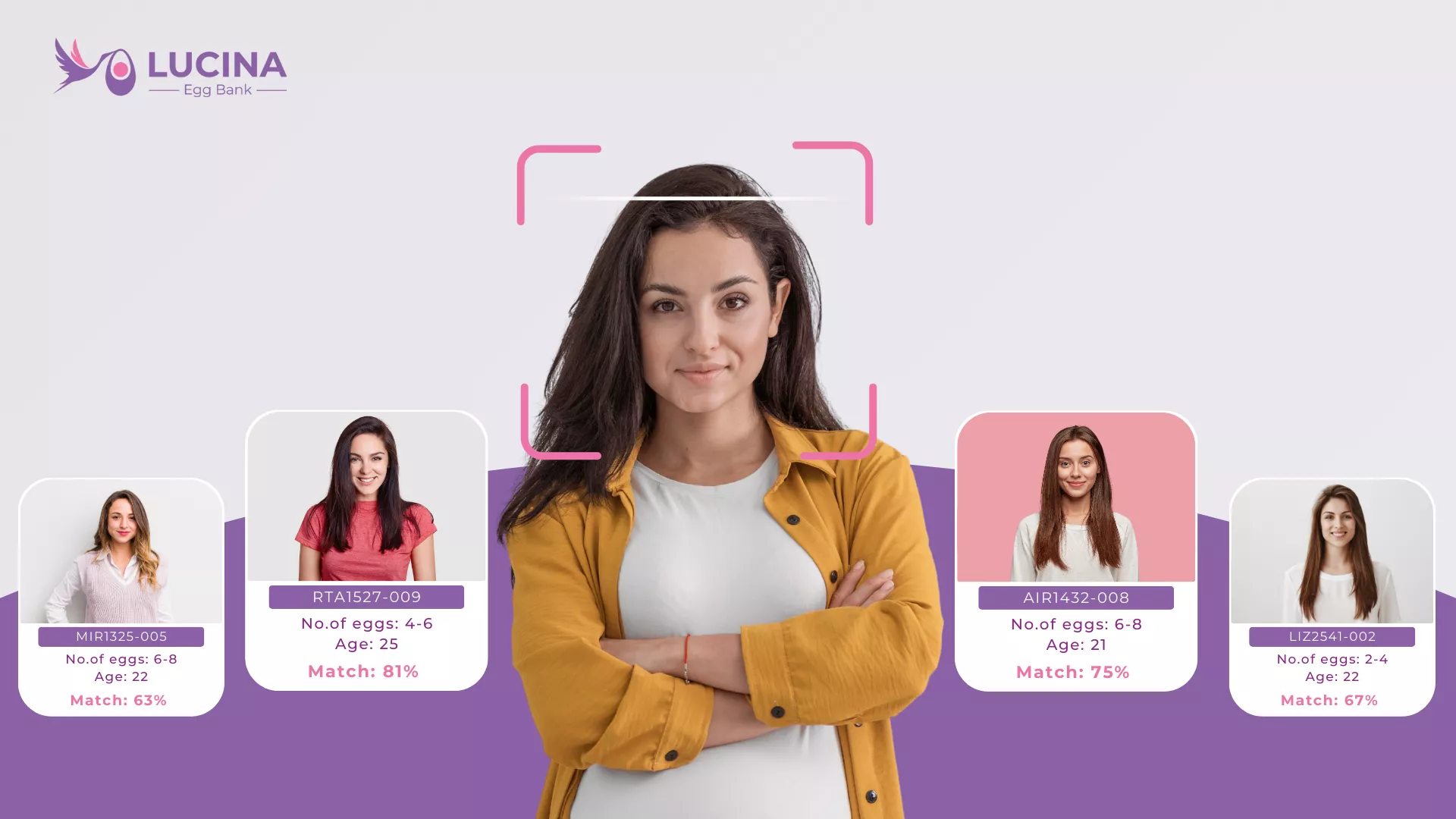
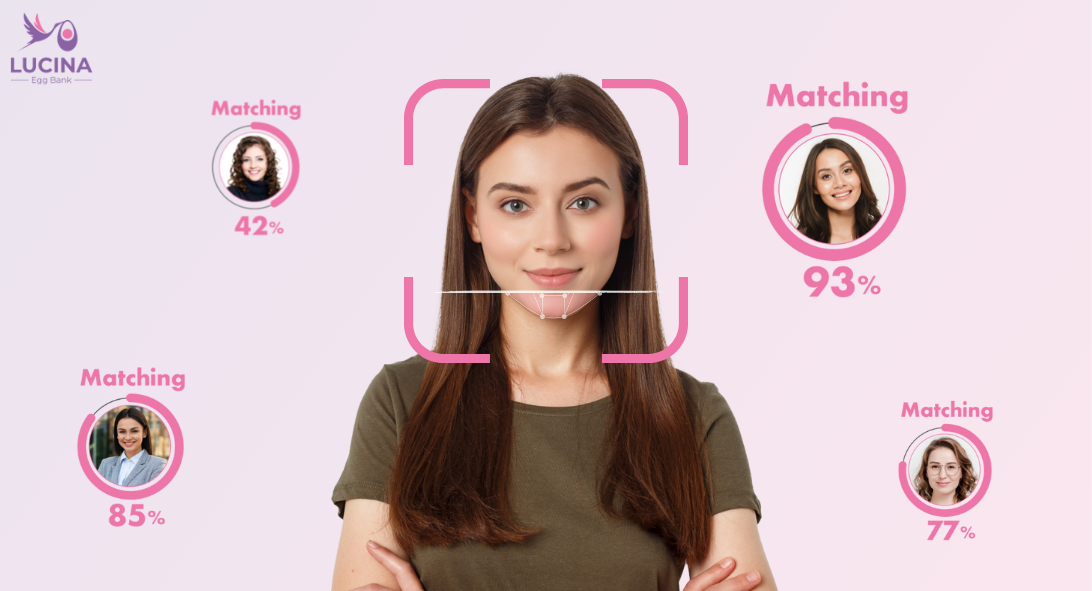
Lucina provides access to more than 3,500 rigorously screened donor profiles representing diverse ethnic and cultural backgrounds. Browse by ethnicity, education, physical characteristics, and health history. The ReflEggction AI matching tool uses facial-recognition technology to identify donors with similar features across the full gallery.
Step 3: Create embryos.
Once your donor cohort is selected, the frozen eggs are shipped to your fertility clinic. The clinic thaws the eggs, fertilizes them via ICSI, and monitors embryo development over 5–6 days. Embryos that reach the blastocyst stage have the strongest implantation potential. Lucina’s 2022 data shows a 92.2% frozen egg survival rate after thaw and an 89.1% ICSI fertilization rate – both well above industry benchmarks.
Step 4: Match with a gestational surrogate.
Surrogate matching is where most journeys either accelerate or stall — and the outcome depends almost entirely on the agency you choose. Traditional agencies screen surrogates after a match is proposed, adding months of post-match clearance. Agencies that complete medical and psychological screening before placing surrogates in the matching pool eliminate this delay entirely. When a surrogate is already medically cleared before you meet her, the time from match to transfer preparation shrinks from months to weeks. A preterm delivery rate 50% below the national average is one marker of what rigorous pre-match screening produces.
Step 5: Complete legal agreements.
Both intended parents and the surrogate work with independent reproductive attorneys on a gestational carrier agreement covering parental rights, compensation, medical decision-making, and expectations during pregnancy. Legal fees typically run $8,000-$15,000 combined. Surrogacy laws vary by state. California, Nevada, Washington, and Maine are among the most surrogacy-friendly, offering pre-birth orders that establish parental rights before the baby arrives. Understanding the laws in your surrogate’s state before matching is one of the most important early decisions you make.
Step 6: Surrogate medical clearance and transfer preparation.
Once contracts are signed, the surrogate completes medical clearance at the fertility clinic if not already done – typically 4-6 weeks. She then begins hormonal preparation: estrogen to build the uterine lining, followed by progesterone. Most transfers proceed once the lining reaches 7-10mm. Agencies that complete medical clearance before matching reduce this phase to transfer preparation only, as little as 4 weeks.
Step 7: Embryo transfer.
The transfer takes about 15 minutes. Using ultrasound guidance, the doctor deposits the embryo into the surrogate’s uterus through a thin catheter. No anesthesia is needed. Most clinics transfer one embryo at a time to minimize the risk of multiples while preserving remaining embryos for future cycles.
Step 8: Pregnancy, birth, and legal finalization.
A blood test 10-14 days after transfer confirms implantation. The surrogate then transitions to prenatal care with her OB. In most surrogacy-friendly states, a pre-birth order puts your names on the birth certificate before the baby arrives.
Egg Donor Process Timeline: Frozen vs. Fresh
The choice between frozen and fresh donor eggs shapes your entire timeline.
With a fresh donor cycle, intended parents wait for donor recruitment, medical screening, legal contracts, and retrieval scheduling — typically adding 3–6 months before embryo creation begins.
With frozen donor eggs, the eggs are already retrieved and immediately available. Embryo creation can begin within weeks of donor selection.
| Feature | Frozen Donor Eggs (Lucina) | Fresh Donor Cycle |
|---|---|---|
| Donor availability | Immediate | Requires donor coordination |
| Embryo creation | Can begin quickly | Delayed until retrieval |
| Scheduling complexity | Lower | Higher |
| Prepare embryos before surrogate clearance | Yes | Often delayed |
| Timeline predictability | Higher | More variable |
| Cost (egg donation) | From $19,000 (guaranteed) | $25,000–$45,000+ |
What does the full journey look like?
The surrogacy timeline depends on one variable above all others: whether your agency pre-screens surrogates before or after matching.
| Phase | Pre-screened agency model | Traditional agency model |
|---|---|---|
| Surrogate matching | ~1 week | 2–6 months |
| Post-match medical clearance | Already complete | 2–5 months added |
| Time from match to transfer-ready | Weeks | Months |
With Lucina’s guaranteed programs and a pre-screening surrogacy agency, intended parents typically reach the clinical pregnancy point in around 3 months. Traditional programs commonly take 15–18 months to reach the same milestone.
| Phase | Typical duration |
|---|---|
| Initial consultations (clinic + agency) | 1–2 weeks |
| Donor selection and cohort preparation | 1–3 weeks |
| Embryo creation | 1–2 weeks |
| Surrogate matching (pre-screened agency) | ~1 week |
| Legal contracts | 2–4 weeks |
| Transfer preparation | 4–6 weeks |
| Clinical pregnancy point | ~3 months from selection |
| Pregnancy through birth | ~38 weeks |
| Total: first consultation to birth | ~12 months |
Individual timelines vary based on surrogate availability, state legal requirements, transfer success, and pregnancy progression.
The Cost of Surrogacy With Donor Eggs
Surrogacy with donor eggs involves two separate financial components.
The Surrogacy Component
Surrogacy costs in the U.S. vary depending on surrogate location, agency structure, insurance coverage, medical complexity, and the number of transfers required.
The main categories to budget for are agency coordination, surrogate compensation, legal agreements for both parties, insurance and medical screening, embryo transfer procedures, prenatal care and delivery, and contingency expenses.
Legal fees typically run $8,000–$15,000 combined. A contingency reserve of $15,000–$25,000 is standard guidance, though agencies that complete medical screening before matching tend to have fewer late-stage surprises, since surrogates are already cleared before contracts are signed.
The Egg Donation Component
Lucina’s programs are fixed-price guarantees — your financial commitment is defined before you begin.
Blastocyst Guarantee
At least one viable blastocyst per cohort. If the first cohort doesn’t yield a blastocyst, up to two additional cohorts are provided.
PGT-A Guarantee
One PGT-A-passed blastocyst per cohort, with up to two replacement cohorts if needed.
Pregnancy Guarantee
Start with three cohorts totaling 18 donor eggs. If the initial eggs and resulting embryos do not lead to pregnancy, Lucina provides another 18 eggs across three complimentary cohorts.
Financing is available through partners, including CapexMD and PatientFi, for families who want to spread payments over time.
What the Success Data Shows
Surrogacy with donor eggs produces some of the highest pregnancy rates in reproductive medicine. Egg quality and uterine health can both be optimized independently, which is what makes the combination so effective.
Lucina’s 2022 verified outcomes:
| Metric | Lucina (2022) | Industry average |
|---|---|---|
| Clinical pregnancy rate | 61.5% | 47.6% |
| Frozen egg survival rate | 92.2% | 63.5% |
| ICSI fertilization rate | 89.1% | 52.9% |
| Blastocyst formation rate | 54.1% | 40.8% |
Partner clinics using Lucina’s frozen eggs report a 77% mean first-transfer pregnancy rate (as reported by partner clinics). These rates hold relatively consistently regardless of recipient age, because the embryo’s chromosomal health comes from a donor at peak reproductive health.
Emotional Considerations
Most families arrive at this decision after a long road – failed cycles, a difficult diagnosis, or years navigating a system not designed with them in mind. For gay male couples and single fathers, that often meant building an entire plan from scratch. For heterosexual couples, it may have meant letting go of what they imagined their path would look like.
Working with a therapist who specializes in third-party reproduction is one of the most practical steps you can take – not because something is wrong, but because this journey has distinct emotional milestones that benefit from specific support.
Start With Your Donor While the Surrogate Search Runs in Parallel
Frozen eggs mean embryo creation doesn’t have to wait for surrogate matching to finish. Choose a donor today, create embryos, and arrive at the transfer stage ready.
3,500+ screened donor profiles · 92.2% frozen egg survival rate (2022) · 61.5% clinical pregnancy rate (2022)
$0 to browse the gallery. Triple Guarantee programs available. ReflEggction AI matches donors by facial recognition.
Frequently Asked Questions
Does a surrogate use her own eggs? +
Do surrogates use their own eggs? +
In surrogacy, whose egg is used? +
When you use a surrogate, is it your eggs? +
Can you use donor eggs and a surrogate together? +
How long does the full egg donor and surrogate journey take? +
What is the cost of surrogacy with an egg donor? +
What happens if the first embryo transfer doesn’t work? +
Can gay male couples use both partners’ sperm with donor eggs? +
How do frozen donor eggs help shorten the surrogacy process? +

Julianna Nikolic
Chief Strategy Officer Julianna Nikolic leads strategic initiatives, focusing on growth, innovation, and patient-centered solutions in the reproductive sciences sector. With 26+ years of management experience and a strong entrepreneurial background, she brings deep expertise to advancing reproductive healthcare.