Fresh vs. Frozen Donor Egg Costs: Prices, Fees & Key Differences
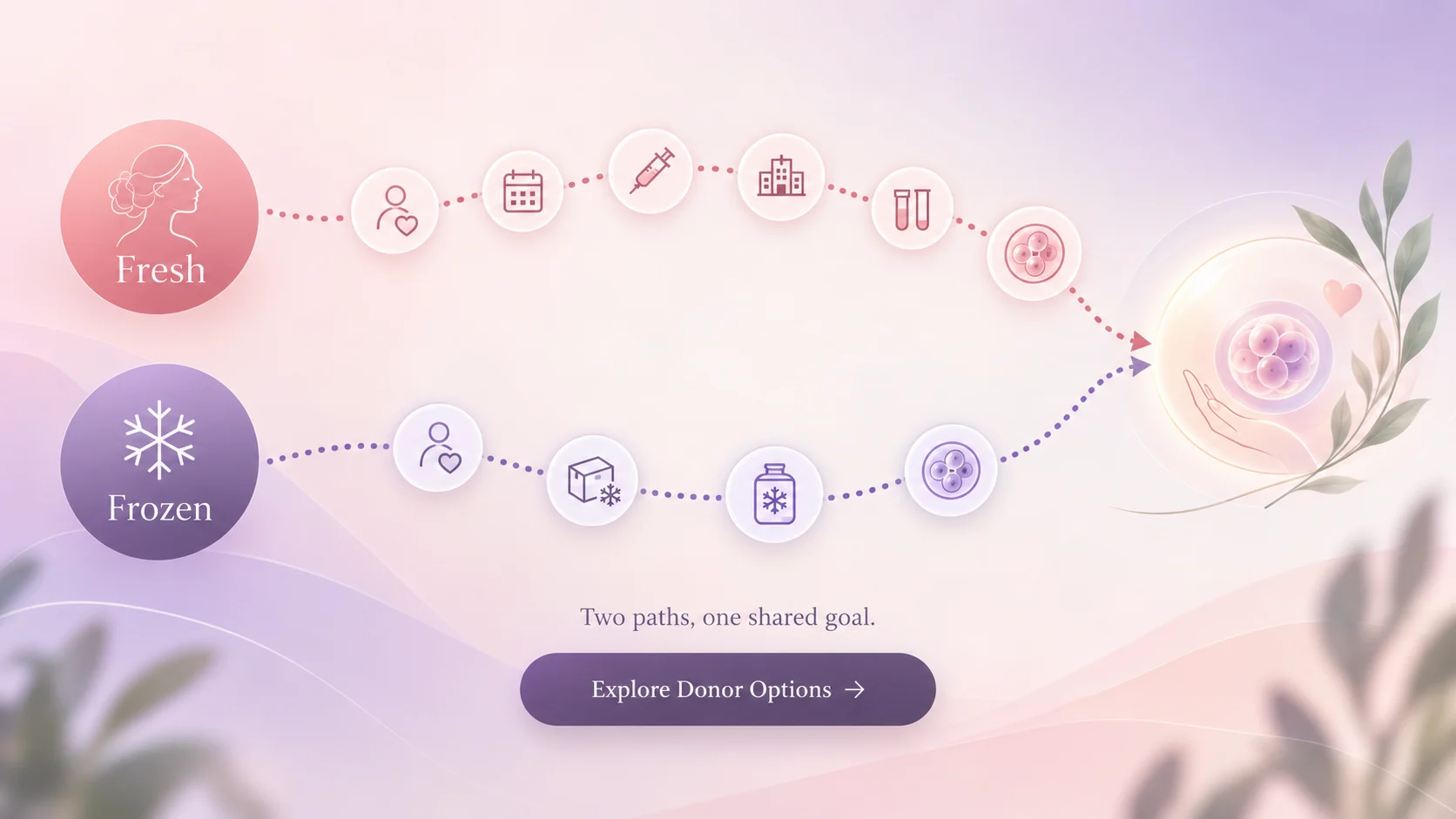
Fresh and frozen donor eggs can both be used to create embryos, but their costs, timelines, and logistics work differently.
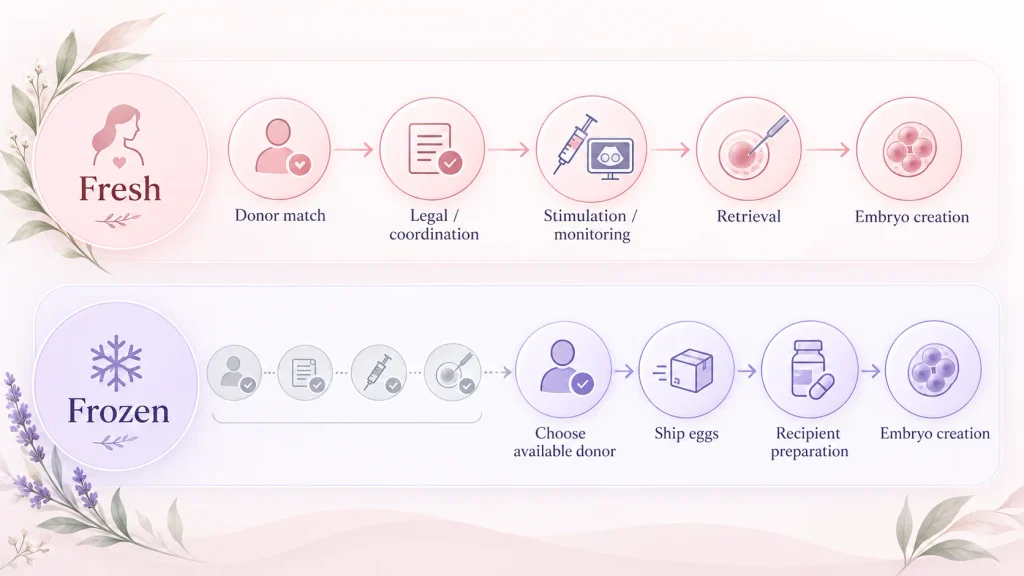
With a fresh donor cycle, your matched donor still needs to complete screening, ovarian stimulation, monitoring, and retrieval — those donor-side steps are billed as separate line items as the cycle unfolds.
With frozen donor eggs, retrieval has already happened: Lucina offers defined purchasing options, from a six-egg Single Cohort up to an entire donor retrieval, at a defined program price you know before treatment begins.

Your fertility clinic will still bill its own fees separately on either path — for services like fertilization, embryo culture, transfer medications, storage, or genetic testing.
The sections below walk through what each path actually costs, how they differ beyond price, and what to expect on success rates, timing, and guarantees.
Key Takeaways
Fresh and frozen donor eggs have different cost structures Frozen cycles use a fixed-price model that includes donor compensation and retrieval. Fresh cycles have variable costs for medications, travel, and legal fees that can change throughout the process.
Frozen donor eggs usually shorten the process. The donor’s stimulation and retrieval are already complete, removing several scheduling steps.
Egg quantity matters. Fresh cycles depend on retrieval yield; frozen options provide a known allocation at purchase.
Success outcomes are nuanced. Pregnancy rates per embryo transfer are broadly comparable, while some newer data show lower live birth rates with frozen donor oocytes in certain comparisons.
Lucina’s frozen donor egg pricing starts at $19,000, with additional clinic, shipping, medication, storage, and optional testing costs billed separately.
How Much Do Donor Eggs Cost?
At a glance, a frozen donor egg option from Lucina starts at $19,000 for a Single Cohort — a defined price that includes your egg cohort and donor compensation.
Fresh donor egg cycles in the U.S. commonly run about $35,000–$55,000 or more, because donor compensation, medications, retrieval, travel, legal work, and clinic services are often billed as separate line items rather than one defined program price.
Those headline numbers only tell part of the story. Neither figure includes every fertility-clinic expense that may apply, such as embryology and IVF services, recipient medications, storage, or optional testing like PGT-A.
Ask what’s included, what your clinic will bill separately, and how many eggs you’re receiving before comparing one program against another.
Understanding Fresh-Cycle Expenses
A fresh donor egg cycle requires the donor’s screening, stimulation, monitoring, and retrieval to happen after you match, and it brings several categories of cost that may be billed separately and change as the cycle unfolds:
- Donor compensation
- Agency or coordination fees
- Donor screening
- Stimulation medications and monitoring
- Egg retrieval and anesthesia
- Donor travel and lodging, if needed
- Legal representation and agreements
- Fertility clinic embryology and IVF services
- Embryo transfer-related treatment
- Genetic testing, if selected
- Embryo freezing and storage
These costs are not standardized across programs. Some agencies bundle several services into one fee, while others itemize them.
Frozen donor eggs skip the donor-side portion of this list because retrieval has already happened. That is one reason a defined egg-bank price can be established before treatment begins.
Ask your agency and clinic for an itemized quote before committing, since bundling practices vary.
Lucina’s Frozen Egg Pricing
Lucina currently offers several ways to access frozen donor eggs:
| Option | Eggs | Price |
|---|---|---|
| Single Cohort | 6 | $19,000 |
| Double Cohort | 12 | $33,000 |
| Full Batch | Entire retrieval | $45,000 |
| Pregnancy Guarantee Package | 18-egg starting allocation | $49,800 |
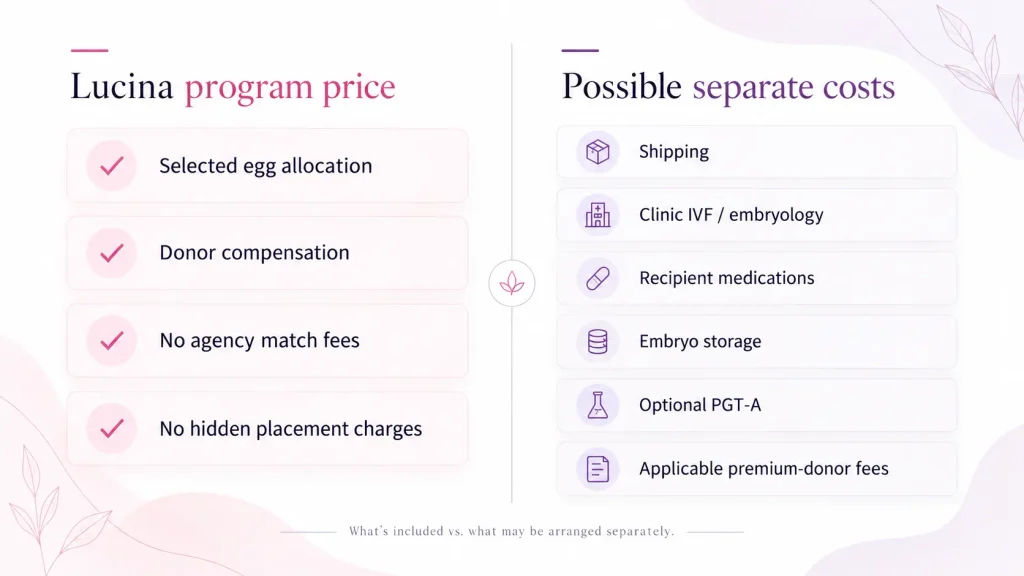
The program price includes your selected donor egg allocation and donor compensation, with no agency match fees or hidden placement charges.
Billed separately: shipping to your clinic, your fertility clinic’s embryology and IVF fees, recipient medications, embryo storage, PGT-A genetic testing if selected, and premium fees for select specialty donors.
Ask both Lucina and your clinic for a current, itemized quote so you can see the full treatment budget beyond the program price.
EXPLORE AVAILABLE DONORS
See Which Donors Are Available Now
Browse detailed donor profiles before deciding which egg allocation may fit your plans.
Browse Donor Profiles — Free Instant AccessWhat Changes Beyond Cost?
Price is only one difference between fresh and frozen donor eggs:
| Feature | Fresh Donor Egg Cycle | Frozen Donor Egg Cycle (Lucina) |
|---|---|---|
| Eggs retrieved | After you match with a donor | Already retrieved and stored |
| Donor stimulation | Still required | Already completed |
| Cycle synchronization | Required | Not required |
| Egg quantity known upfront | No — determined after retrieval | Yes — cohort size stated at purchase |
| Donor availability | May involve matching and a wait | Choose from existing inventory |
| Geographic flexibility | May depend on donor travel | Eggs can ship to your clinic; shipping billed separately |
Frozen donor eggs are preserved using vitrification, an ultra-rapid freezing method designed to minimize ice-crystal formation inside the egg.
ASRM’s evidence-based guidance on oocyte cryopreservation describes vitrification as the standard rapid-cooling approach used to improve post-warming survival compared with older slow-freezing methods.
Practically, the donor portion of treatment is already complete once frozen eggs enter inventory.
What Do Success Rates Show?
The evidence on fresh versus frozen donor eggs deserves more nuance than either “fresh is better” or “they’re the same.”
ASRM’s donor-oocyte cryopreservation guideline found good evidence that pregnancy rates per embryo transfer are not significantly different between fresh and previously vitrified donor oocytes, but concluded the evidence was insufficient to say live birth rates are identical.
A 2024 national study of 135,085 donor-oocyte embryo transfer cycles adds more recent context: frozen donor oocytes were associated with somewhat lower live birth rates than fresh in several 2018–2020 comparisons.
At the same time, among singleton live births, rates of delivering a healthy-birthweight baby at term were comparable between fresh and frozen donor-oocyte groups.
In practice, pregnancy rates per embryo transfer are well-supported as comparable, while some recent data show lower live birth rates with frozen donor oocytes in certain comparisons.
Among singleton live births, term healthy-birthweight outcomes were similar. Lab quality — post-thaw survival, fertilization, and embryo culture protocols — is also part of the picture, alongside the number of eggs available, embryo transfer strategy, and recipient health.
Your clinic’s outcomes and the success measures used in donor egg treatment are worth reviewing alongside this national evidence.
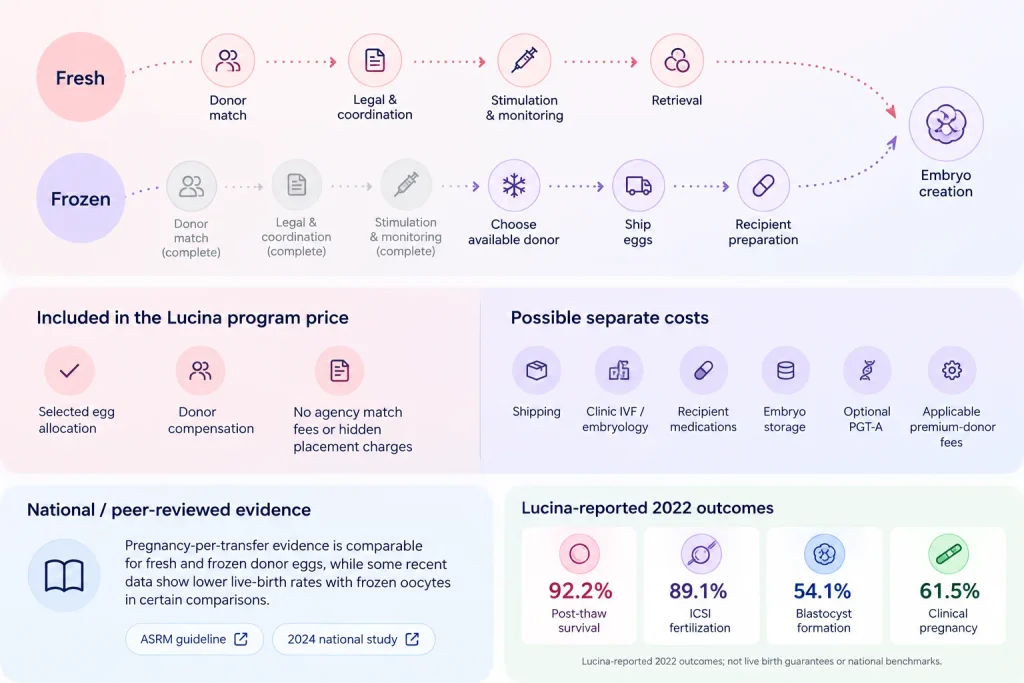
Lucina’s own 2022 lab performance data adds a program-specific data point:
| Metric | Rate |
|---|---|
| Post-thaw survival | 92.2% |
| ICSI fertilization | 89.1% |
| Blastocyst formation | 54.1% |
| Clinical pregnancy rate | 61.5% |
These are Lucina’s reported laboratory and clinical outcomes, not live birth guarantees or national benchmarks.
How Long Does Each Option Take?
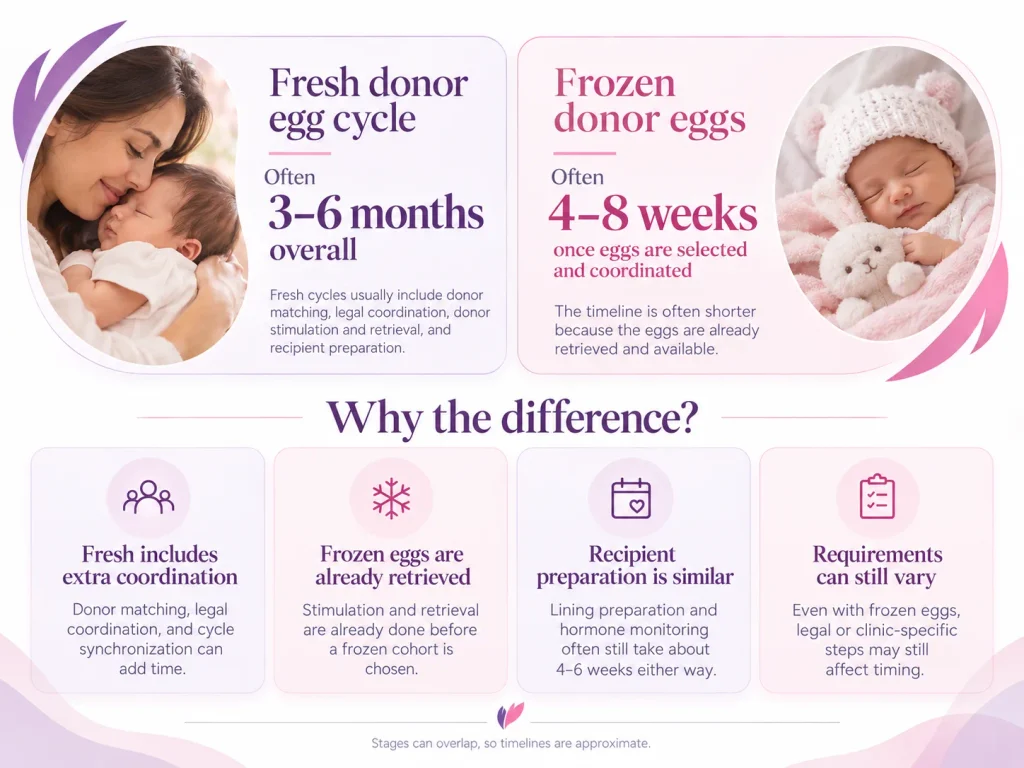
Fresh donor cycles add donor matching, legal coordination, cycle synchronization, stimulation, and retrieval before embryo creation. Frozen eggs remove those donor-side scheduling steps. The ranges below are general U.S. industry estimates, not Lucina guarantees, and several stages can overlap rather than occurring one after another.
| Milestone | Fresh Donor Egg Cycle | Frozen Donor Eggs |
|---|---|---|
| Donor selection | Variable; often several weeks and may take longer depending on donor availability and matching criteria | Choose from currently available profiles |
| Legal agreements | Often about 2–3 weeks for agency or directed-donor arrangements | Requirements vary by program and arrangement |
| Cycle synchronization | Required; timing depends on clinic protocol | Not required |
| Donor stimulation & retrieval | About 10–14 days, plus monitoring | Already completed |
| Recipient preparation | Often about 4–6 weeks | Often about 4–6 weeks |
| Estimated time to embryo transfer | Often about 3–6 months overall | Often about 4–8 weeks once eggs are selected and treatment is coordinated |
Egg Quantity and Future Family Plans
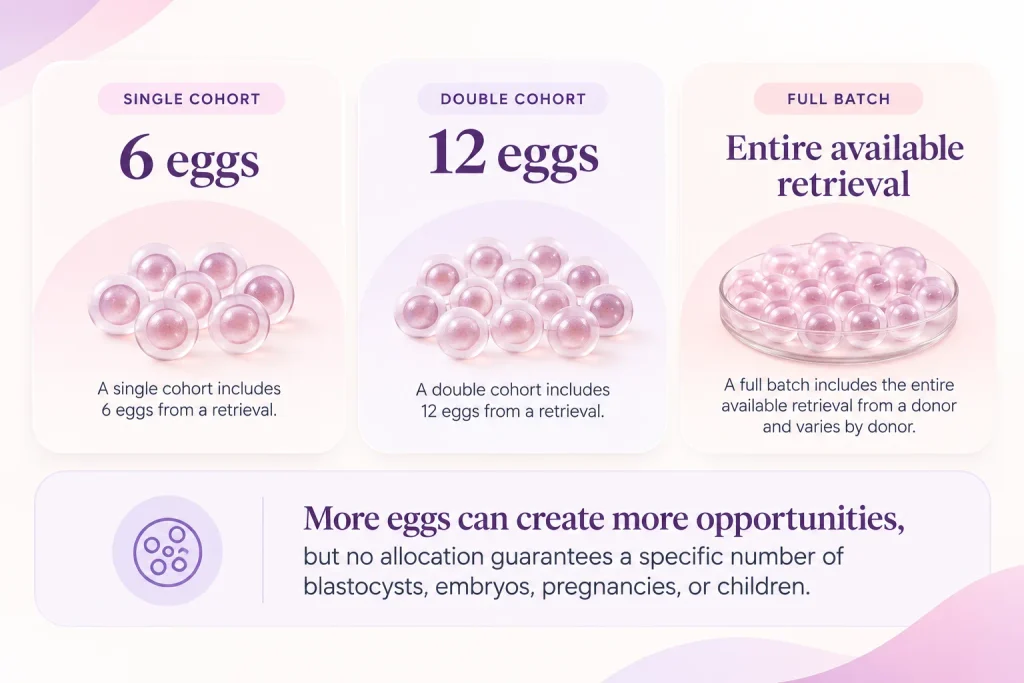
The number of eggs you receive can matter just as much as the starting price. A Single Cohort contains six eggs. A Double Cohort contains 12.
A Full Batch includes the donor’s entire available retrieval, so the number varies by donor rather than being fixed at six or 12.
A fresh donor cycle provides whatever the donor’s stimulation cycle yields — the number is not known until after retrieval, which makes a simple price-per-egg comparison incomplete.
A lower starting price does not automatically mean a lower eventual cost if you later need additional eggs, and paying for more eggs never guarantees a specific number of blastocysts, embryos, pregnancies, or children.
ASRM’s evidence on vitrified donor oocytes also found that warming more donor oocytes was associated with a higher cumulative live birth rate, which is one reason egg quantity belongs in the cost conversation.
If you hope to have more than one child from the same donor, it is worth asking your care team:
- How many eggs are included in the option I’m considering?
- How many embryos might my clinic reasonably expect from that allocation?
- Would a Double Cohort or Full Batch better fit my family plans?
- Could additional eggs from the same donor be available later?
- How should my plans for PGT-A affect the number of eggs or embryos I need?
If PGT-A is part of your plan, how PGT-A works with donor eggs can also affect how you think about embryo numbers and cohort size.
The right comparison is not simply price per egg. It is whether the egg allocation, clinical plan, and total expected cost align with your goals.
Which Option May Fit Your Priorities?
There is no universal right answer. The better fit depends on your goals, timeline, budget preferences, and treatment plan.
Frozen donor eggs may be the better fit if:
- You want to move forward without waiting on a donor’s future cycle
- Budget predictability matters to you
- You’re coordinating internationally or across a complicated schedule
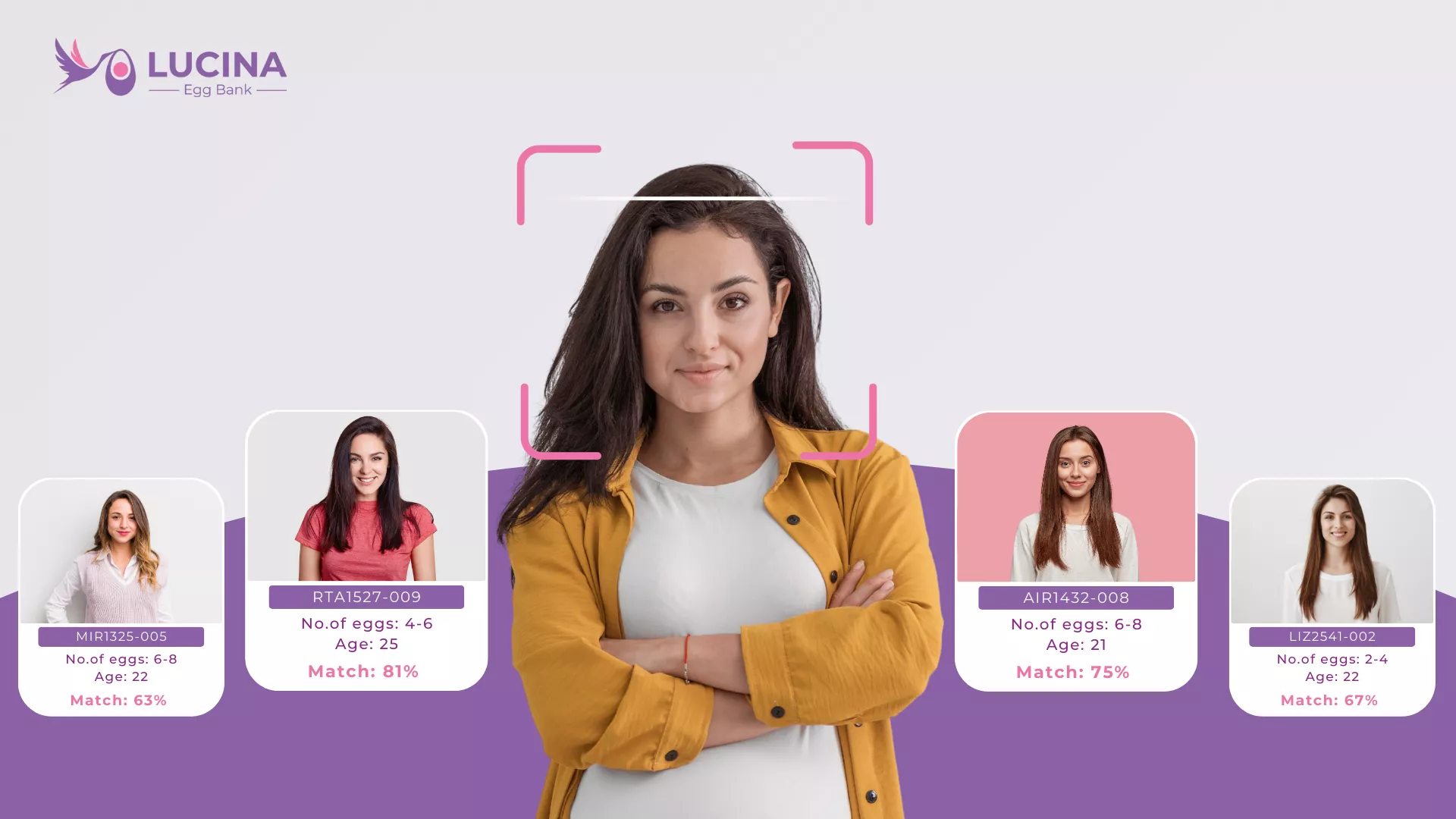
- You want to browse a large gallery of immediately available donors, including with Lucina’s AI-assisted matching tool
- You want milestone-based guarantee coverage built into your program
- You want to choose between a six-egg cohort, 12 eggs, or an entire retrieval
A fresh cycle may be worth considering if:
- You want the eggs from one future retrieval, whatever it yields
- A particular donor is available only through a fresh program
- Your clinic recommends a fresh cycle based on your specific situation
- Cost and timeline are not significant constraints
If predictability, donor availability, and a shorter coordination timeline matter most to you, frozen donor eggs may offer practical advantages.
Your clinic can help you weigh those factors against egg quantity and your treatment goals. A personalized cost estimate can then show how Lucina’s program price and your clinic-side expenses fit together.
Lucina’s Guarantee Programs
Lucina offers three programs tied to different clinical milestones. Eligibility and program terms apply.
Blastocyst Guarantee — $19,000
One six-egg cohort. If no viable blastocyst develops, one complimentary six-egg cohort.
PGT-A Guarantee — $25,000
One six-egg cohort. If no PGT-A-passed embryo develops, one complimentary six-egg cohort.
Pregnancy Guarantee — $49,800
Begins with 18 eggs across three cohorts. If those eggs and resulting embryos do not lead to pregnancy under the program definition, up to another 18 eggs across three complementary cohorts.
Pregnancy is confirmed by either a second positive hCG test or an ultrasound showing a heartbeat. Valid for three years. Does not guarantee live birth.
Eligibility and program terms apply. Lucina’s guarantee program terms explain the full eligibility requirements and conditions for each option.
THREE MILESTONES
Compare Lucina’s Guarantee Programs
See how the Blastocyst, PGT-A, and Pregnancy Guarantee programs differ by milestone, pricing, and eligibility.
Compare Guarantee ProgramsFinancing and Costs to Plan For
Your donor egg program price is only one part of the overall treatment budget. Depending on your circumstances, other ways to manage costs may include fertility-specific financing, employer fertility benefits, personal or home-equity financing, and HSA or FSA funds for eligible fertility-related medical expenses.
Coverage and eligibility vary by plan and provider. Check directly with your insurance carrier, benefits administrator, tax adviser, and fertility clinic before assuming a particular expense is covered. Lucina’s fertility financing options include current partner details and application information available to intended parents.
Frequently Asked Questions
How much do frozen donor eggs cost?
How much can a fresh donor egg cycle cost?
What costs are separate from Lucina’s program price?
Are fresh or frozen donor eggs more successful?
How long does treatment with frozen donor eggs take?
How many eggs are in a Lucina cohort?
What if I want more than one child?
What happens if no blastocyst develops?
Can frozen donor eggs be shipped internationally?
Does PGT-A work differently with fresh vs. frozen eggs?
Does insurance cover donor eggs?
Should I look at my egg bank’s success data or my fertility clinic’s?
Ready to Compare Your Options?
Start with available donor profiles, or talk with Lucina about how program pricing and clinic-side costs may fit your plan.

Julianna Nikolic
Chief Strategy Officer Julianna Nikolic leads strategic initiatives, focusing on growth, innovation, and patient-centered solutions in the reproductive sciences sector. With 26+ years of management experience and a strong entrepreneurial background, she brings deep expertise to advancing reproductive healthcare.

Table of Contents
- How Much Do Donor Eggs Cost?
- Understanding Fresh-Cycle Expenses
- Lucina's Frozen Egg Pricing
- What Changes Beyond Cost?
- What Do Success Rates Show?
- How Long Does Each Option Take?
- Egg Quantity and Future Family Plans
- Which Option May Fit Your Priorities?
- Lucina's Guarantee Programs
- Financing and Costs to Plan For
- Frequently Asked Questions