What’s the Difference Between Egg Donor Agencies and Egg Banks?

Most intended parents reach the egg donor agencies vs. egg banks question after doing a lot of research and still feeling unsure. The terminology overlaps, the pricing is hard to compare directly, and programs on both sides are incentivized to present their model favorably.
This article gives you a straight read on how the two actually differ, what each costs, and which situations each is genuinely better suited for.
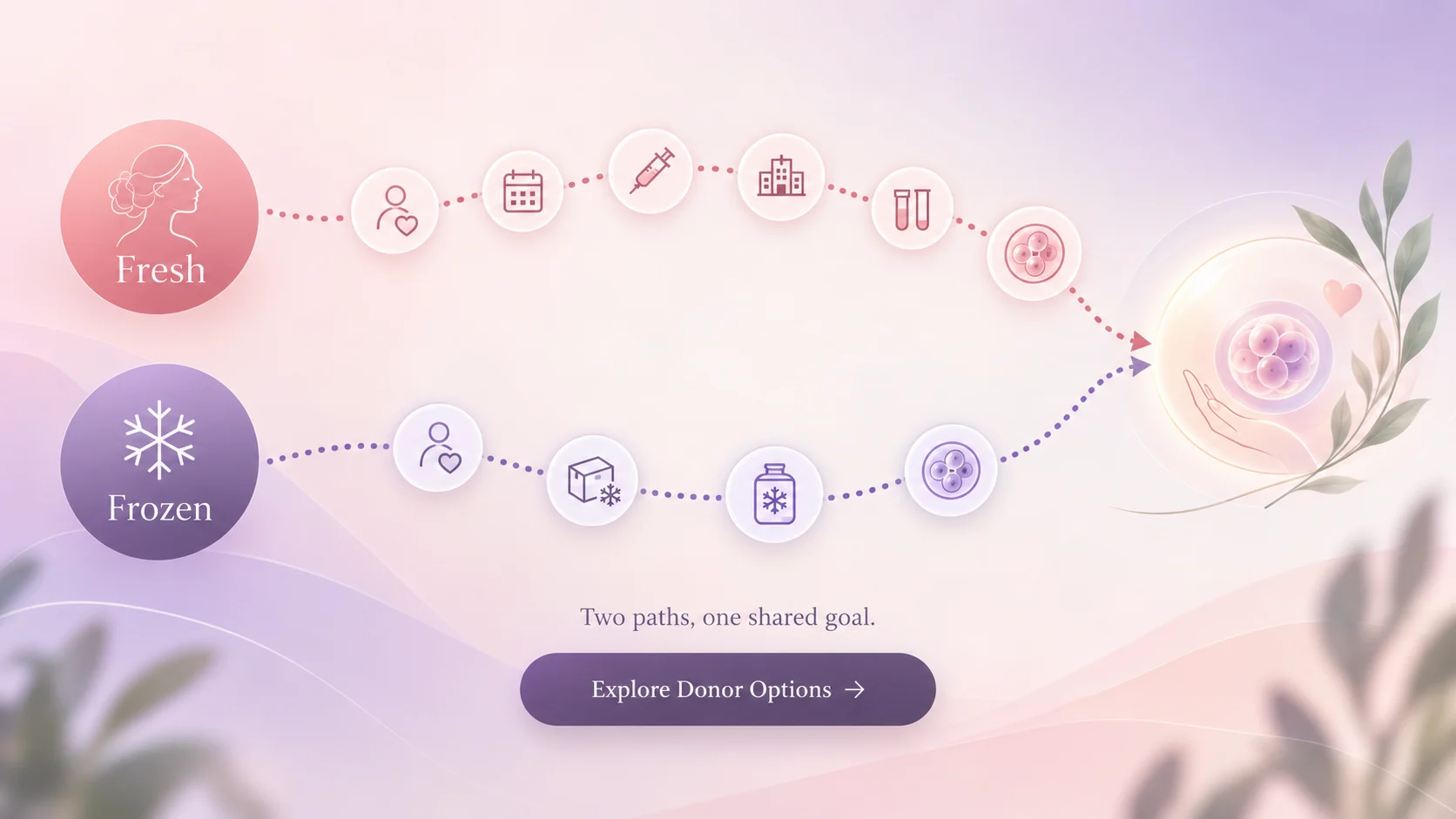
The short version: egg donor agencies coordinate fresh donor cycles for a specific recipient. Egg banks sell pre-screened frozen eggs that ship when you’re ready. The difference in timeline, cost, and risk profile between the two models is larger than most comparison pages let on.

How Each Model Actually Works
The two models differ at a fundamental level: one coordinates a live donor cycle around your schedule, the other ships eggs that are already waiting. Here’s how each operates in practice.
Egg Donor Agencies
An egg donor agency acts as a coordinator. When you select a donor through an agency, that donor hasn’t completed her retrieval yet. She’ll undergo medical and psychological screenings specific to your cycle, then receive hormone stimulation to produce eggs. The retrieval happens for you, on a schedule that has to be synchronized with your IVF clinic’s protocol.
That coordination is the agency’s core function, and it’s also where most of the cost and time goes. A typical fresh-cycle agency process runs 3–6 months from donor selection to retrieval, and the total cost ranges from $20,000 to $40,000+ before IVF clinic fees. You may get more eggs per retrieval on average, but the process has more points of failure.
Frozen Egg Banks
Frozen egg banks work differently. Donors are recruited, screened, and retrieved in advance. The eggs are vitrified and stored. When you select a donor and purchase a cohort, the eggs ship to your IVF clinic, typically within a week. Cycle synchronization is off the table entirely, and a donor backing out mid-process is a non-issue.
The tradeoff is egg count. A frozen cohort is usually 6 eggs. A fresh agency cycle may yield more, though results vary widely by donor. For many intended parents, the predictability and lower cost of the frozen model outweigh the potential yield difference.
Comparing the Two Models in Detail
Cost, timeline, cancellation risk, donor selection, and financial protection all land differently depending on which model you use. Here’s how each factor breaks down.
Cost
The cost gap between agencies and frozen banks is real and consistent. Agency cycles run $20,000–$40,000+ before your IVF clinic’s transfer fees, because you’re paying for the donor’s stimulation medications, retrieval procedure, agency coordination, and legal agreements. If a cycle is cancelled before retrieval, you may lose part or all of that investment, depending on the contract.
Frozen egg bank cohorts typically cost $10,000–$25,000 per cohort of six eggs. Some banks, including Lucina, use flat per-cohort pricing at $16,500 per cohort, with two cohorts at $33,000+.
The eggs are already retrieved and stored, so there’s no stimulation cost to absorb. For a full breakdown, see our guide to frozen donor egg costs.
Timeline
Fresh agency cycles require scheduling around two people: you and the donor. Synchronizing your uterine lining preparation with her stimulation cycle takes coordination, and clinics aren’t always available on the schedule you’d prefer. Add legal agreements, psychological clearances, and stimulation monitoring and you’re typically looking at 3–6 months before a transfer is even possible.
With a frozen egg bank, the donor’s cycle is already done. You select a cohort, the eggs ship to your clinic, and your clinic schedules a thaw and transfer when you’re ready. Lucina ships frozen eggs globally within a week of cohort selection. For many parents who’ve already been through one or more failed cycles, that timeline difference matters a great deal.
Cycle Cancellation Risk
This is the comparison point most agency pages don’t address directly. In a fresh cycle, the donor is a variable. Some donors don’t respond adequately to stimulation and produce too few follicles to proceed. Others withdraw before retrieval. When that happens, your cycle is cancelled, your timeline resets, and depending on the contract, some costs may not be refundable.
Frozen egg banks eliminate this risk entirely. The eggs exist. They’ve been retrieved, vitrified, and quality-checked. You’re choosing from available inventory, which means the result of your cycle depends on the lab, the embryologist, and your own physiology, not on a donor’s stimulation response.
Donor Selection
Egg donor agencies typically offer detailed profiles including educational background, photos, personal statements, and medical history. The profile depth can be substantial, and some intended parents find the level of detail reassuring. The donor is, in a sense, chosen specifically for you before her cycle begins.
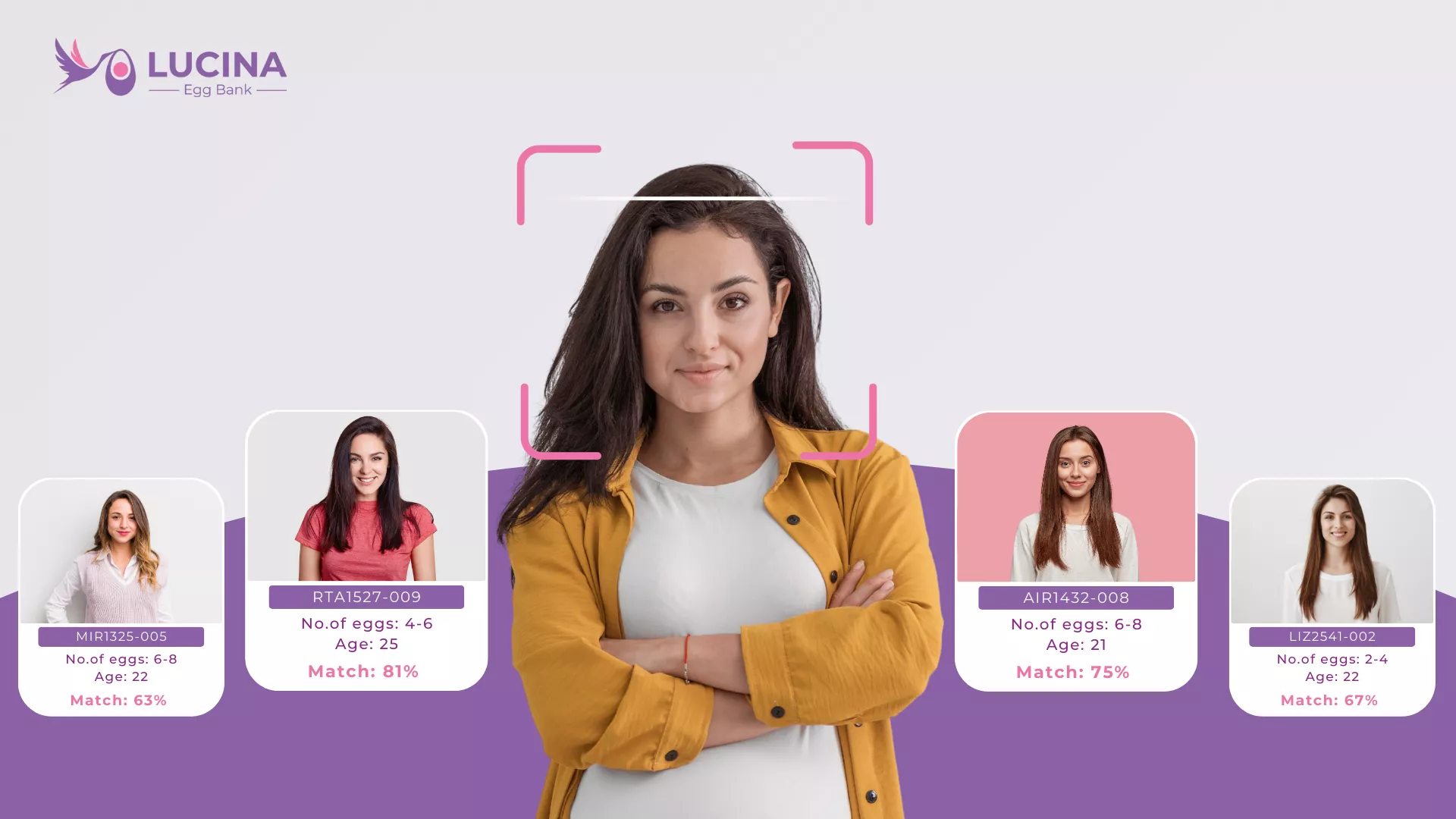
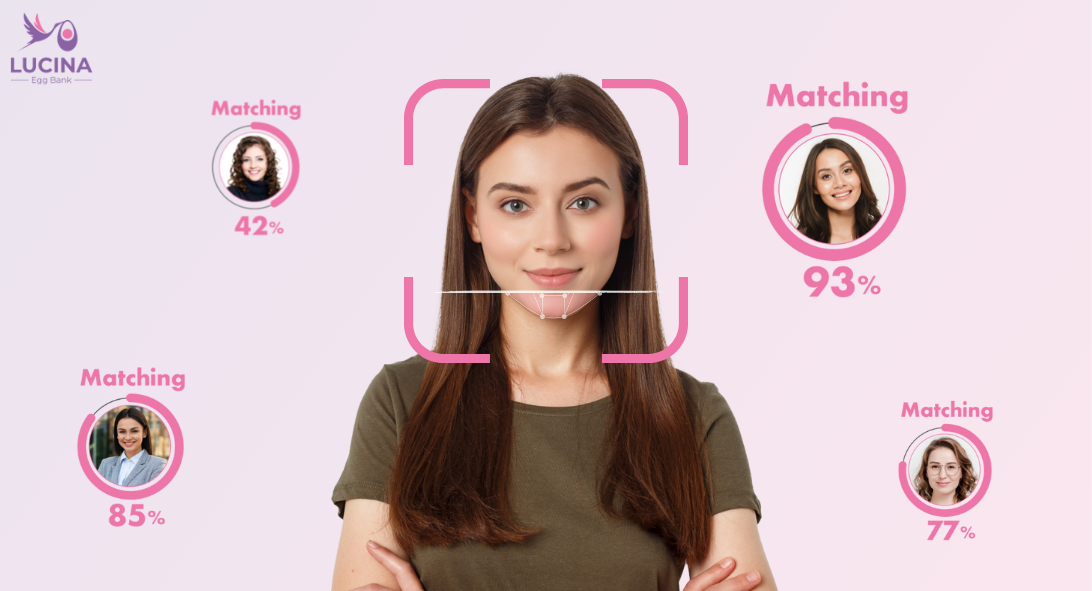
Frozen egg banks also offer detailed profiles with the added option of technology-assisted matching. Lucina’s ReflEggction® AI analyzes facial geometry and phenotypic features to identify donors whose physical traits closely resemble the intended parent.
It’s the first facial recognition donor matching tool in the U.S. and reduces search time by up to 70%. You can browse Lucina’s gallery of 3,500+ pre-screened donors at no cost before committing to anything.
Success Rates
The “fresh eggs are better” assumption is outdated. Vitrification technology has advanced to the point where frozen egg survival rates at high-quality banks are comparable to, and in some cases exceed, fresh cycle outcomes.
The industry average frozen egg survival rate is around 63.5%, per ASRM published data. Lucina’s 2022 outcomes show a 92.2% survival rate and a 89.1% ICSI fertilization rate.
The clinical pregnancy rate per transfer was 61.5%, compared to an industry average of 47.6%. Those numbers reflect rigorous donor screening and vitrification protocols, the kind of results a high-quality bank can deliver when AMH/AFC testing filters the donor pool before acceptance.
Survival Rate
Fertilization Rate
Rate per Transfer
Financial Protection
Guarantee programs are more common and more structured in the frozen egg bank space than in fresh-cycle agencies. Lucina’s Triple Guarantee covers three milestones: a Blastocyst Guarantee, a PGT-A Guarantee, and a Pregnancy Guarantee, each with replacement cohorts if a defined benchmark isn’t met.
The Pregnancy Guarantee is available at $49,800 and covers up to 3 cohorts with complimentary cohorts option if conditions are satisfied. For more on how the guarantee tiers work, see our donor egg guarantee programs article.
Fresh-cycle agencies may offer cycle repeat or shared-risk programs, but terms vary and aren’t standardized. Parents who’ve already spent money on failed cycles often find the structured protection available through frozen banks a deciding factor.
See Lucina’s full gallery of 3,500+ pre-screened donors at no cost. Review health histories, genetic screening results, and AMH/AFC data before making any commitment.
Browse Donors Free →When Each Option Makes More Sense
There are scenarios where egg donor agencies genuinely offer something frozen banks don’t. Parents who want a fresh cycle with a higher per-retrieval egg count, or who have a specific donor profile in mind that isn’t available in any bank’s existing inventory, may find the agency model worth the additional cost and time.
For most intended parents, the frozen bank model fits better. The cost is lower, the timeline is dramatically shorter, and there’s no cancellation risk.
The fresh vs. frozen comparison goes deeper on the clinical specifics if you want a more detailed breakdown of the science behind vitrification outcomes.
Ask any program you’re considering: “What happens if my donor doesn’t respond to stimulation?” and “What does your guarantee actually cover?” The answers will tell you more than any marketing page does.
What to Look for in a Frozen Egg Bank (vs. an Agency)
Frozen banks vary widely in quality. Published outcomes data varies considerably, and some banks publish nothing at all. Before committing to a cohort, and before ruling out egg donor agencies entirely, ask for these specifics:
- Egg thaw survival rate. Industry average is around 63.5%. Banks with rigorous AMH/AFC testing and mature MII oocyte-only vitrification standards typically report 85–93%.
- ICSI fertilization rate. This is partly donor-dependent and partly lab-dependent. Ask what year the data is from.
- Clinical pregnancy rate per transfer. This is the number intended parents actually care about. Rates above 55% represent strong performance for frozen donor eggs.
- Guarantee coverage. Read the full terms. Know exactly what triggers a replacement cohort and what conditions the clinic must meet.
- Donor screening depth. Does the bank test AMH and AFC before accepting donors? How many generations of family health history are collected? Our guide to egg donor screening covers what rigorous screening actually looks like.
Lucina publishes its outcomes data and lets intended parents browse the full donor gallery at no cost before committing. The $0 upfront access includes donor health histories, genetic screening results, photos, and AMH/AFC data.
See How a Frozen Egg Bank Compares in Practice
Browse Lucina’s full donor gallery at no cost. Review health histories, genetic screening results, and AMH/AFC data before making any decision. ReflEggction® AI can match donors by facial resemblance in minutes.
92.2% frozen egg survival rate (2022) · 61.5% clinical pregnancy rate (2022) · 3,500+ screened donor profiles
$0 upfront to browse donors. Triple Guarantee programs available. Eggs ship globally within a week of selection.
Frequently Asked Questions

Julianna Nikolic
Chief Strategy Officer Julianna Nikolic leads strategic initiatives, focusing on growth, innovation, and patient-centered solutions in the reproductive sciences sector. With 26+ years of management experience and a strong entrepreneurial background, she brings deep expertise to advancing reproductive healthcare.