Best Egg Banks and Egg Agencies (2026): The Complete Guide for Intended Parents

Comparing Options for the Family You’re Building
You’ve probably spent hours comparing donor profiles, pricing pages, and guarantee terms across a dozen open tabs. Searching for a donor egg bank in the USA shouldn’t mean piecing the whole picture together yourself.
The hard part isn’t finding options — it’s knowing which differences actually matter for the family you’re building. Screening standards, published outcomes, guarantee terms, and matching tools can vary considerably from one U.S. egg bank to another.
Lucina Egg Bank built this comparison using publicly available provider information and published outcome data. The goal is to help you compare leading U.S. donor egg programs using the same criteria.

Key Takeaways
- Frozen egg banks offer pre-screened, ready-to-ship eggs. Fresh-cycle agencies typically require more time and coordination and may cost more.
- Look beyond headline pricing. Guarantee programs, genetic screening depth, and ovarian reserve testing (AMH/AFC) all shape the clinical, financial, and practical experience.
- Lucina Egg Bank uses ReflEggction™, AI-powered facial-resemblance donor matching that reduces search time by up to 70%.
- Guarantee programs are tied to real clinical milestones — blastocyst development, a PGT-A-passed embryo, or confirmed pregnancy — with complimentary donor egg cohorts if a milestone isn’t reached.
- Donor pool diversity, clinical compatibility screening, and family medical history depth vary considerably between providers.
Egg Bank vs. Agency: Which Model Fits
Egg banks and agencies serve the same goal but operate differently, and the distinction affects your timeline, budget, and donor options.
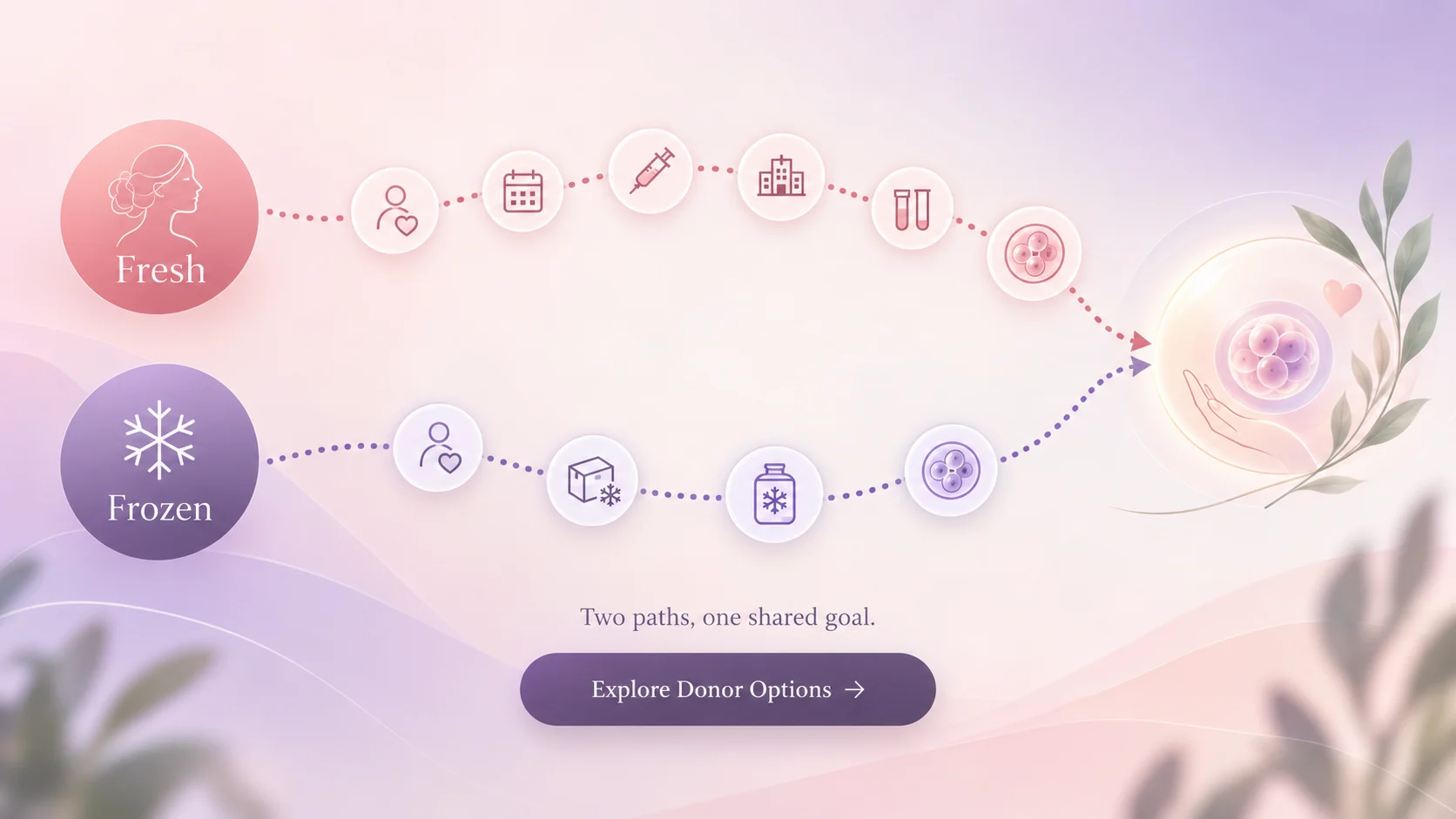
A frozen egg bank stores donor eggs that have already been retrieved, while a fresh-cycle agency coordinates a new retrieval after a donor is matched with intended parents.
Frozen egg banks pre-screen and vitrify donor eggs before you select them. Once you select a donor, the eggs can be shipped to your clinic without coordinating a new stimulation cycle. Because retrieval is already complete, you aren’t depending on the selected donor completing a future stimulation cycle.
Agencies coordinate fresh egg donation cycles instead. The donor stimulates and retrieves eggs specifically for you, which can mean more eggs per cycle on average. But it costs $20,000 to $40,000+ and takes several months to schedule, with higher cancellation risk since the process depends on the donor completing the full cycle.
One caveat: the line between these models has blurred industry-wide. Some providers historically known as fresh-cycle agencies now sell frozen inventory too, so it’s worth confirming which model a specific program is actually offering today rather than assuming from its name.
What We Evaluated
Every program in this guide was assessed on the same criteria — the factors that shape the clinical, financial, and practical experience, not the ones that just look good on a marketing page.
- Donor screening depth: medical history across three generations, genetic carrier screening panels, psychological evaluation, and ovarian reserve metrics (AMH and AFC).
- Matching precision: whether a program filters solely by phenotype, or layers in clinical compatibility and family medical history depth.
- Published success rates: egg thaw survival and clinical pregnancy rates, with year attribution.
- Financial protection: what a guarantee program actually covers, what triggers additional support, and what’s excluded.
- Donor pool size: total screened donors and how often new profiles are added.
- Responsiveness and care: how each team handles questions, for both intended parents and donors.
6 Donor Egg Programs Compared (2026)
Lucina Egg Bank
Best for: parents who want AI-powered resemblance matching, milestone-based financial protection, and published clinical outcomes.
Lucina is a frozen egg bank headquartered in San Diego with 3,500+ screened donors, making it one of the largest egg banks in the U.S., with a top 5% donor acceptance rate. Every donor completes genetic carrier screening, full medical and psychological evaluations, and a three-generation family health history review, along with ovarian reserve testing (AMH and AFC).
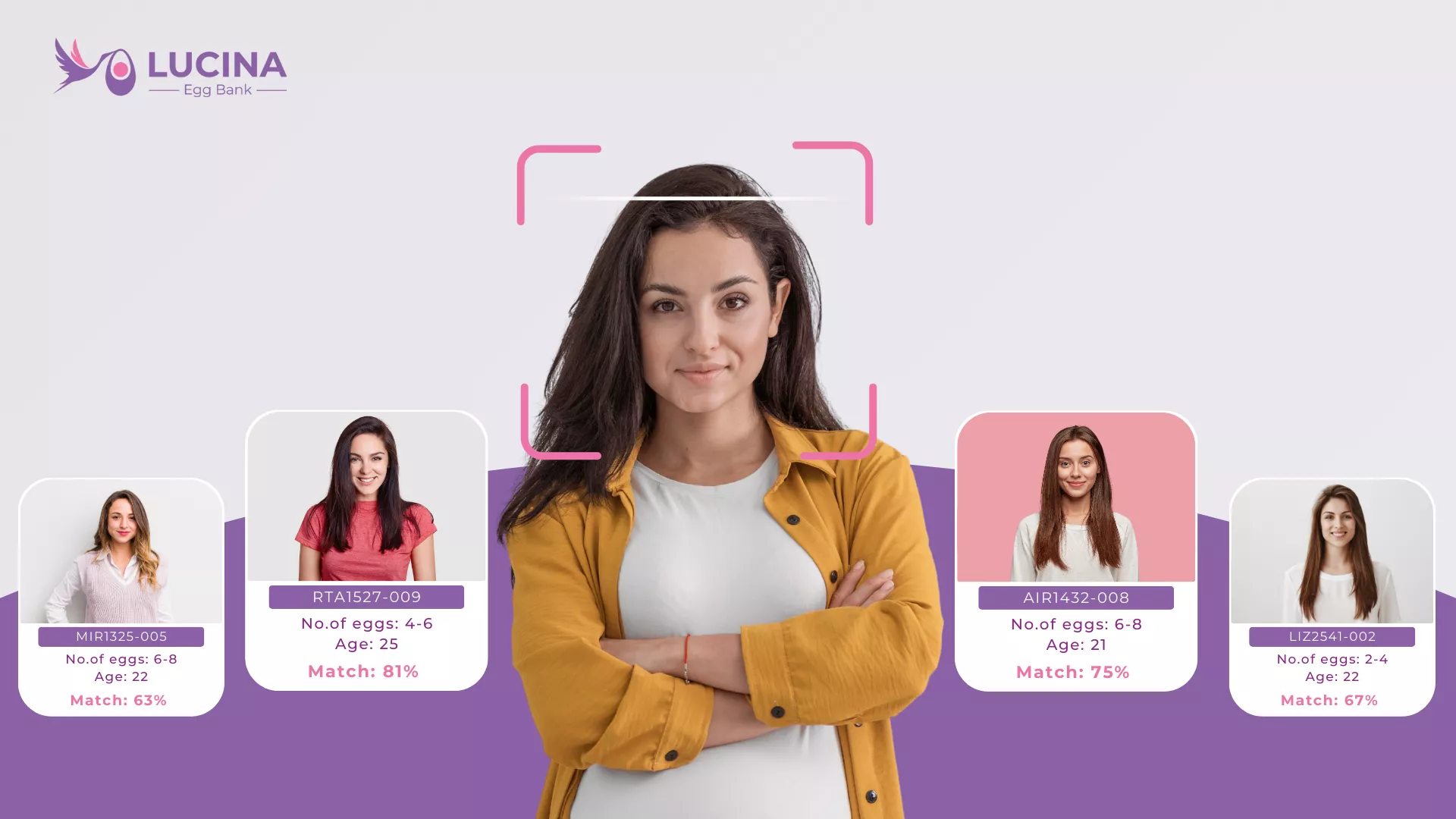
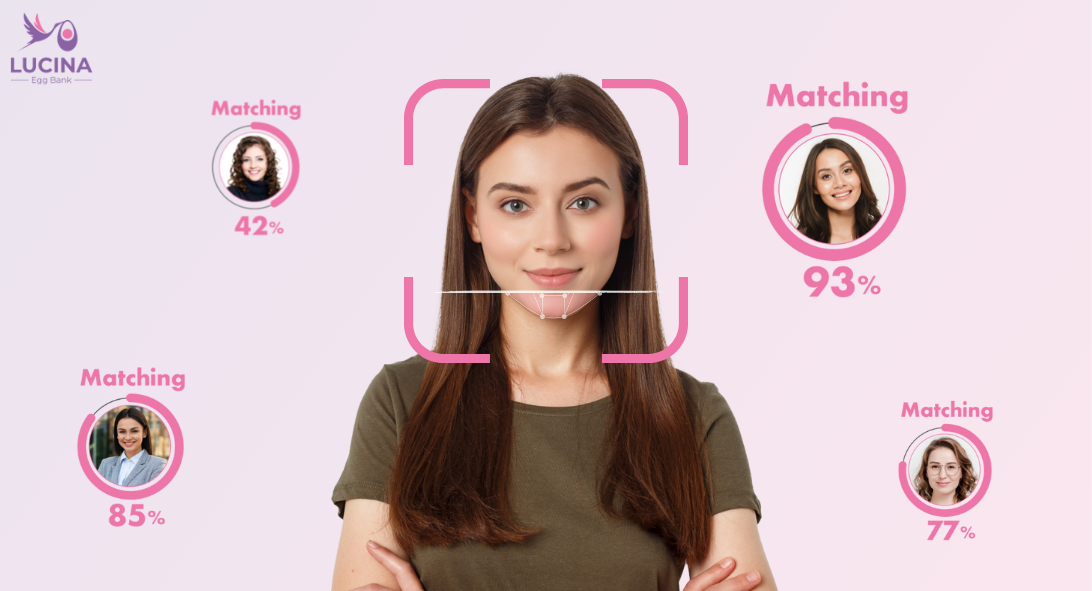
ReflEggction™, Lucina’s AI-powered facial-resemblance donor matching tool, analyzes phenotypic data points to find donors who closely resemble the intended parent — reducing typical search time by up to 70%.
In 2022, Lucina achieved a 92.2% frozen egg survival rate and a 61.5% clinical pregnancy rate. Donor screening follows FDA requirements and ASRM guidance.
Lucina offers three guarantee programs — Blastocyst, PGT-A, and Pregnancy Guarantee — each tied to a specific treatment milestone, with complimentary donor egg cohorts if that milestone isn’t reached.
Intended parents can browse the full donor gallery with $0 upfront, paying only when ready to proceed. Lucina’s full donor catalog details what each profile includes. Frozen eggs ship globally via secure cryogenic transport. The team is BBB Accredited, with leadership bringing 30+ years of combined reproductive medicine experience to the program.
Browse the full gallery with $0 upfront.
Fairfax EggBank
Best for: parents who want a large established clinic network and expanded genetic carrier screening options.
Fairfax has operated since 2006 as a subsidiary of the Genetics & IVF Institute (GIVF), with a strict donor acceptance rate. They partner with 450+ IVF clinics across the U.S., Canada, Mexico, Brazil, and Israel.
Fairfax’s own current published data (2025) shows a 91% egg thaw survival rate and a 67% pregnancy rate.
Matching relies on traditional filtering (ethnicity, hair color, eye color, education). Donors must live within two hours of a partner clinic. Fairfax offers a Complete Cohort blastocyst guarantee, plus broader “Promise” plans — Fairfax’s own product name — that extend protection well beyond the basic blastocyst guarantee, with terms that vary by plan and outcome.
Donor Egg Bank USA
Best for: parents who want fixed, published plan pricing rather than a shared-cohort model.
Donor Egg Bank USA publishes tiered egg-lot plans — including single- and double-lot options — with fixed pricing published on their site. Donor screening follows FDA requirements. Guarantee terms and eligibility vary by plan.
MyEggBank
Best for: patients who want to access frozen donor eggs through their local fertility clinic, with a menu of assurance-program options.
Operates a clinic-partner model distributing frozen donor eggs through partner clinics across North America; pricing and donor availability vary by clinic. All donors complete FDA-required screening. MyEggBank offers a menu of assurance programs, including one that includes PGT-A testing, and also offers fresh donation cycles at select locations — unusual among primarily frozen-focused egg banks.
The World Egg and Sperm Bank
Best for: international parents who need specialized global shipping protocols.
Arizona-based, entirely in-house from donor recruitment through cryopreservation and shipping. Their published data (updated September 2025) shows a 92.1% egg survival rate and a 58.2% worldwide clinical pregnancy rate per ova thawing.
Several named plans — including Premium Embryo Option™ and Premium Banked Eggs™ — include a guarantee tied to blastocyst development. International shipping adds cost.
Egg Donor America
Best for: parents comparing another frozen-inventory option alongside the banks above.
Egg Donor America now markets its frozen egg inventory under the name “Egg Bank America,” with eggs available for immediate shipment. Their current guarantee: at least one blastocyst per batch, or a replacement batch of eggs at no additional charge if that isn’t met.
Side-by-Side Comparison
This comparison uses publicly available information from each provider’s official website and published materials, current as of September 2026. Where a provider hasn’t published specific data, we note it as “not publicly listed.”
Outcome definitions, denominators, patient populations, and reporting methods vary by provider, so published percentages should not be interpreted as direct head-to-head clinical comparisons.
| Program | Matching & Screening | Published Outcomes | Financial Protection |
|---|---|---|---|
| Lucina Egg Bank | Ref1eggction™ AI facial resemblance matching; 3,500+ screened donors; top 5% acceptance rate | 92.2% egg survival, 61.5% clinical pregnancy (2022) | Blastocyst, PGT-A & pregnancy guarantee programs |
| Fairfax EggBank | Traditional filter-based matching; 450+ partner clinics; strict acceptance rate | 91% thaw rate, 67% pregnancy rate (2025, Fairfax-published) | Complete Cohort blastocyst guarantee; broader “Promise” plans extend protection further (Fairfax’s own naming) |
| Donor Egg Bank USA | Fixed-price egg-lot plans; FDA-compliant screening | Not publicly listed | Guarantee terms vary by plan |
| MyEggBank | Clinic-partner model; experience varies by location | Not centrally published | Menu of assurance programs, including one with PGT-A included |
| The World Egg and Sperm Bank | In-house operation; specializes in international shipping | 92.1% egg survival, 58.2% worldwide clinical pregnancy per ova thawing (2025, company-published) | Several named plans include a blastocyst-development guarantee |
| Egg Donor America | Frozen inventory marketed as Egg Bank America; batch-based donor selection | Not publicly listed | Per-batch blastocyst guarantee (replacement batch per their current site) |
What Should You Look for in Egg Donor Screening?
Look for FDA-required donor eligibility screening plus clear information about genetic testing, family medical history, psychological evaluation, and ovarian reserve assessment. FDA requirements under 21 CFR Part 1271, Subpart C establish a regulatory baseline for donor eligibility and screening.
ASRM’s gamete and embryo donation guidance adds professional recommendations on top of that floor, covering donor screening, ovarian reserve assessment, psychological evaluation, genetic evaluation, and family medical history. Programs can differ substantially in the screening and evaluation they perform beyond FDA requirements.
AMH and AFC testing help assess ovarian reserve and anticipated response to stimulation — programs that test for this before accepting a donor are filtering by clinical viability, not just phenotype.
The breadth of genetic carrier screening panels varies considerably between programs. Family medical history depth is another gap: some programs collect one generation of history, others trace three generations, catching patterns single-generation screening misses — one of several genetic compatibility factors in donor matching worth understanding before you compare programs.
Frozen Egg Banking: Why It’s the Flexible Choice
A frozen egg donor bank retrieves eggs from screened donors and preserves them through vitrification — a fast-freezing process, designed to preserve mature donor eggs for later use, that prevents ice crystal formation.
Because the eggs are already retrieved and frozen, there’s no need to coordinate a donor’s cycle with yours. You can move forward with IVF whenever you’re ready, choosing from a pool of donors who have already completed the donation process, rather than waiting on one donor’s cycle to begin.
Once your clinic receives the cohort, the eggs are thawed and fertilized. Resulting embryos are cultured for several days and may then be tested, cryopreserved, or transferred according to your treatment plan.
ASRM’s evidence-based guideline on oocyte cryopreservation outcomes reports that longer storage duration has not been associated with lower egg-survival or pregnancy rates in the available evidence.
Cryogenic storage is designed to keep eggs stable for long-term storage, and specialized shipping containers maintain the required freezing conditions throughout transit — which is how a California-based bank can serve intended parents anywhere in the world, not only those nearby.
How Do Lucina’s Guarantee Programs Work?
Lucina offers three guarantee programs tied to blastocyst development, a PGT-A-passed embryo, or confirmed pregnancy. If the defined milestone isn’t reached, the applicable program provides additional donor eggs under its terms.
Each program is tied to real clinical milestones. If your first eggs don’t reach the milestone you’ve chosen, you have another opportunity to move forward. Eligibility and program terms apply.
| Program | Price | Starting Cohort | If the Milestone Isn’t Reached |
|---|---|---|---|
| Blastocyst Guarantee | $19,000 | One cohort of six donor eggs | One complimentary six-egg cohort if no blastocyst develops |
| PGT-A Guarantee | $25,000 | One cohort of six donor eggs | One complimentary six-egg cohort if no PGT-A-passed embryo develops |
| Pregnancy Guarantee | $49,800 | Three cohorts totaling 18 donor eggs | Another 18 eggs across three complimentary cohorts if the initial eggs and resulting embryos do not lead to pregnancy |
Additional pricing options: The Blastocyst Guarantee is also available with two cohorts for $33,000 or three cohorts for $45,000; a premium fee applies to certain donors. PGT-A Guarantee pricing also includes a $6,000 per-cohort option. Program eligibility and terms apply.
Under the Pregnancy Guarantee, pregnancy is confirmed by either a second positive hCG test or an ultrasound showing a heartbeat. The program is valid for three years and does not guarantee a live birth. A Lucina coordinator can review each option with you before enrollment.
What if it doesn’t work? If a defined milestone isn’t reached, Lucina provides the additional donor eggs specified by that guarantee program, so your next step is already covered. With the Blastocyst and PGT-A Guarantees, that’s one complimentary six-egg cohort. With the Pregnancy Guarantee, it’s another 18 eggs across three complimentary cohorts. Your coordinator will walk through the terms with you before you enroll.
Eligibility requirements and full program terms vary by guarantee.
Flash Sale Donor Lot Option
A limited number of donors are periodically available through Lucina’s Flash Sale Donor Lot option — a separate, selected-donors-only offer, not one of the three standard guarantee programs above.
| Bundle | Price | Guarantees | If the Milestone Isn’t Reached |
|---|---|---|---|
| 12-Egg Bundle | $21,000 | 1 blastocyst | Up to one additional 6-egg cohort if no blastocyst is created |
| 18-Egg Bundle | $29,000 | 2 blastocysts | Up to one additional 6-egg cohort if fewer than 2 blastocysts are created |
This option is limited to selected donors and availability changes; ask a Lucina coordinator which donors currently qualify. Eligibility and program terms apply.
Review the full Blastocyst, PGT-A, and Pregnancy Guarantee terms.
What Role Does Matching Technology Play
Traditional egg donor matching works like a filter on a shopping site — you select hair color, eye color, ethnicity, height, and education level, and the database returns matching profiles. ReflEggction™ works differently: it’s Lucina’s AI-powered facial-resemblance matching tool, analyzing facial geometry, bone structure, and phenotypic features at a level manual browsing can’t replicate.
For parents who care about physical resemblance between their child and their family, this changes the search process. Traditional filtering handles broad categories well but can’t assess facial similarity — that’s the gap AI-powered matching fills, cutting typical search time by up to 70%.
California Egg Banking: Southern & Northern California Options
That same evaluation lens applies with extra weight to Southern California egg banking, where the sheer number of programs makes the differences above easier to overlook. California is a major hub for fertility care and donor egg programs.
Its legal framework explicitly protects egg donors and intended parents. Its concentration of reproductive endocrinologists and fertility clinics is also unusually dense.
Its large donor pools give intended parents more options than in many other states. FDA-regulated frozen eggs also ship globally via secure cryogenic transport, so working with a California-based egg bank doesn’t require being in California. Canadian intended parents exploring U.S. donor options can find country-specific guidance in Lucina’s guide for Canadians considering a U.S. egg bank.
Southern California — San Diego, Los Angeles, and Orange County
The San Diego–Los Angeles–Orange County corridor has a high concentration of fertility clinics and a large, accessible donor population. Lucina is headquartered in San Diego, at 3661 Valley Centre Dr., Suite 160, San Diego, CA 92130. That makes it the most direct geographic access point to the program for Southern California intended parents.
Los Angeles and Orange County intended parents can generally work through their own fertility clinic without traveling to San Diego for the egg-bank portion of treatment; the clinic receives donor eggs via cryogenic shipping.
Northern California — Bay Area and Beyond
Bay Area intended parents can use Lucina as a frozen egg bank while continuing treatment through their local fertility clinic. That clinic receives eggs via cryogenic shipping from the San Diego facility, so no travel south is required.
The same logistics apply for Sacramento, Fresno, and other inland California cities: your fertility clinic is the receiving end of the shipping chain regardless of where in California you’re located.
What to Look for in a California Frozen Egg Bank
- Donor pool size and screening standards — infectious disease testing, genetic carrier screening, AMH/AFC testing, psychological evaluation, and three-generation family medical history.
- Published outcome data — post-thaw survival rate, ICSI fertilization rate, and clinical pregnancy rate, with the year they’re from.
- Pricing transparency — per-cohort cost, number of eggs per cohort, shipping, and genetic testing fees stated upfront, with no hidden add-ons.
- Matching technology — whether the program offers AI-powered matching or only manual profile browsing.
- Financial protection — guarantee programs tied to defined clinical milestones.
Lucina Egg Bank is one of the largest egg banks in the U.S., with 3,500+ screened donors and a top 5% donor acceptance rate. In 2022, Lucina’s post-thaw egg survival rate was 92.2% and its clinical pregnancy rate was 61.5%.
How to Choose the Best Egg Bank in the USA: 8 Questions to Ask
Bring these questions to any consultation call. A program that answers them directly is one that’s confident in its process.
- How long have you been operating, and what is your donor acceptance rate?
- Do donor profiles include three generations of medical history, and what does your genetic carrier panel test for?
- What is your published thaw survival rate, and what year is it from?
- Can I see a line-by-line cost breakdown — donor coordination, medical processing, and shipping itemized separately?
- What guarantee programs do you offer, and exactly what do they provide if a milestone isn’t reached?
- Do you require separate legal counsel for the donor and the intended parents?
- What is your anonymity / donor ID-disclosure policy?
- How quickly can you ship after I select a donor, and do you handle international customs paperwork?
Choosing the Right Program for Your Situation
There’s no single “best” program for everyone — your priorities should guide the decision.
- If published success-rate transparency matters most: compare programs that actually share their numbers. Lucina, Fairfax, and The World Egg and Sperm Bank each publish outcome data; other banks in this comparison haven’t made outcome data public.
- If resemblance matching is your top priority: ReflEggction™ is currently the only AI-powered tool of its kind among the programs compared here.
- If you want the largest clinic-partner network: Fairfax’s 450+ partner clinics offer broad geographic coverage.
- If fixed, published pricing matters most: Donor Egg Bank USA’s tiered lot plans offer that structure.
- If you’re outside the United States: both Lucina and the World Egg and Sperm Bank offer international shipping, through different service models.
Frequently Asked Questions
Our donor egg FAQs answer the questions intended parents ask most before choosing a program.
What is the difference between an egg bank and an egg donor agency?
How much do donor eggs cost from a frozen egg bank?
What is a good frozen egg survival rate?
What happens if my cohort doesn’t reach a guarantee milestone?
Can I browse donor profiles before paying anything?
How large is Lucina’s donor pool?
Does Lucina serve Bay Area and Northern California intended parents?
Can Lucina ship frozen eggs to clinics outside the US?
How long can frozen donor eggs be stored?
Start Comparing Your Options
The best egg banks share one thing in common: they let the data speak instead of relying on vague promises. Ask for published outcomes, understand exactly what a guarantee program covers, and evaluate screening depth before committing to any program.
Lucina Egg Bank offers AI-powered donor matching through ReflEggction™, milestone-based guarantee programs, and published 2022 clinical outcomes.

Julianna Nikolic
Chief Strategy Officer Julianna Nikolic leads strategic initiatives, focusing on growth, innovation, and patient-centered solutions in the reproductive sciences sector. With 26+ years of management experience and a strong entrepreneurial background, she brings deep expertise to advancing reproductive healthcare.

Table of Contents
- Comparing Options for the Family You're Building
- Key Takeaways
- Egg Bank vs. Agency: Which Model Fits
- What We Evaluated
- 6 Donor Egg Programs Compared (2026)
- Lucina Egg Bank
- Fairfax EggBank
- Donor Egg Bank USA
- MyEggBank
- The World Egg and Sperm Bank
- Egg Donor America
- Side-by-Side Comparison
- What Should You Look for in Egg Donor Screening?
- Frozen Egg Banking: Why It's the Flexible Choice
- How Do Lucina's Guarantee Programs Work?
- Flash Sale Donor Lot Option
- What Role Does Matching Technology Play
- California Egg Banking: Southern & Northern California Options
- Southern California — San Diego, Los Angeles, and Orange County
- Northern California — Bay Area and Beyond
- What to Look for in a California Frozen Egg Bank
- How to Choose the Best Egg Bank in the USA: 8 Questions to Ask
- Choosing the Right Program for Your Situation
- Frequently Asked Questions
- Start Comparing Your Options