
Searching for egg donation near you usually pulls up a mix of local fertility clinics, national egg banks, and sponsored listings. Most women assume they need to find something in their city, but that assumption turns out to be wrong.
National egg donation programs are built to work with donors from any U.S. state. The appointments that happen most often, blood draws and ultrasounds to track follicle development, are done at a fertility clinic near you. Travel for the retrieval itself is arranged and paid for by the program. So “egg donation near me” is far less of a location filter than most searches suggest.
What actually separates good programs from average ones is how much they pay per cycle, how clearly they explain the process, and whether they operate under FDA and ASRM standards. This guide covers all three.

Where can I donate eggs near me? You don’t need to live near a specific clinic or egg bank. Programs like Lucina accept donors from every U.S. state. Monitoring appointments are handled at a fertility clinic in your area, and travel for the retrieval is fully covered by the program.
You Don’t Need a Local Egg Donation Center
Most searches for “egg donation near me” return fertility clinics running small in-house programs. These clinics coordinate fresh egg donation cycles, which require the donor to remain physically nearby throughout. That’s a fundamentally different model from how national frozen egg banks operate.
Frozen egg banks collect and vitrify eggs from donors, then ship them to fertility clinics worldwide when a recipient is matched. This removes the location constraint. You donate once; the eggs go wherever they’re needed. A donor in Ohio can work with a frozen egg bank in San Diego and the process is clinically identical to one performed locally.
There’s also a timing advantage. Because frozen programs store vitrified eggs before a match is confirmed, your donation cycle can start while a recipient is still being identified. Local fresh-cycle programs require both parties to coordinate schedules simultaneously, which adds weeks of waiting.
Appointments fall into two categories. Monitoring visits require blood draws and ultrasounds every few days during stimulation, so they need to be local. You coordinate those with a fertility clinic near you. The retrieval happens once per cycle at a designated clinic. Lucina arranges and covers all travel for that visit.
What Egg Donation Programs Near You Actually Pay
Compensation varies more than most program websites let on. Local fertility clinic programs tend to pay in the $5,000–$10,000 range per cycle, constrained by individual clinic budgets. National egg banks have more room because they serve a larger pool of recipients across many clinics.
Standard donors with us earn $8,000–$15,000+ per cycle. Donors who attended or graduated from a top-ranked university may qualify for our Iconic donor program, which pays up to $50,000 per cycle. The American Society for Reproductive Medicine (ASRM) sets the lifetime ceiling at 6 donation cycles per donor.
Standard donors completing all 6 cycles can earn $90,000+. Iconic donors completing 6 cycles can earn up to $300,000+. Both figures reflect standard ASRM-compliant cycles with no disqualifying medical events between donations.
Per cycle. Up to $90,000+ cumulative over 6 cycles. All travel and medical costs covered.
Per cycle for donors from top-ranked universities. Up to $300,000+ cumulative over 6 cycles.
All medical and travel costs are covered by the program. Compensation is paid after the retrieval is complete.
What to Look for in an Egg Donation Program Near You

Compensation is the clearest comparison point, but a few other criteria tell you whether a program is worth your time before you submit a single form.
FDA screening and ASRM compliance. Both are legally required for licensed egg banks and fertility clinics in the U.S. The FDA governs donor eligibility testing under 21 CFR Part 1271. ASRM sets the clinical guidelines covering stimulation protocols, screening standards, and donation limits. Programs that operate outside either framework present legal and safety risks.
Transparent compensation figures. Good programs give you the per-cycle range before you apply. A program that won’t answer that question directly before you submit personal information is worth approaching with caution. The figure should also reflect the full structure, including whether the program has tiers with different pay rates.
Dedicated coordinator support. Medication timing, monitoring scheduling, and retrieval logistics require real coordination. Programs that assign a dedicated coordinator handle this better than those routing questions through general customer service. Ask how you’ll be supported before you’re matched.
Outcome reporting. Reputable programs in the U.S. report clinical data to SART, the Society for Assisted Reproductive Technology. Programs that cite specific cycle outcomes, rather than vague claims about their reputation, are working from verifiable data. You can also explore Fertile for additional vetted clinic options near you.
If a program can’t give you a clear per-cycle compensation figure before you apply, ask directly. How quickly and specifically they respond is usually a preview of how the entire process goes.
Questions to Ask Before You Apply
These five questions will tell you a lot about how a program actually operates before you commit to it:
- What is the compensation structure, and does it vary by donor tier?
- How long does the full process take, from application to retrieval?
- What health risks or side effects should I know about before starting?
- What support is provided during monitoring and the retrieval itself?
- How are donors matched with recipients, and how long does matching typically take?
Requirements to Donate Eggs Near Me
Egg donation programs, whether local clinics or national egg banks, share similar baseline eligibility criteria. Age is the first filter. ASRM recommends donors between 21 and 34; individual programs set their own windows within or near that range. We accept donors ages 19–31 at Lucina. See the full egg donor requirements for our specific criteria.
Beyond age, you’ll generally need to be in good overall health, maintain a healthy BMI, be a non-smoker, and have no major hereditary conditions that could affect offspring. Programs verify all of this through formal screening. There’s no benefit to self-screening; the medical review is thorough regardless of what you self-report.
Full screening includes a physical exam, AMH testing, genetic carrier screening, and a psychological evaluation. State laws vary on certain aspects of egg donation, including anonymity rules, but all licensed U.S. programs operate under federal FDA guidelines regardless of state. Medical staff review every application before confirming eligibility.
How the Egg Donation Process Works
Whether you apply to a local clinic or a national egg bank, the clinical path is the same. Here’s where local monitoring fits in and what to expect at each stage.
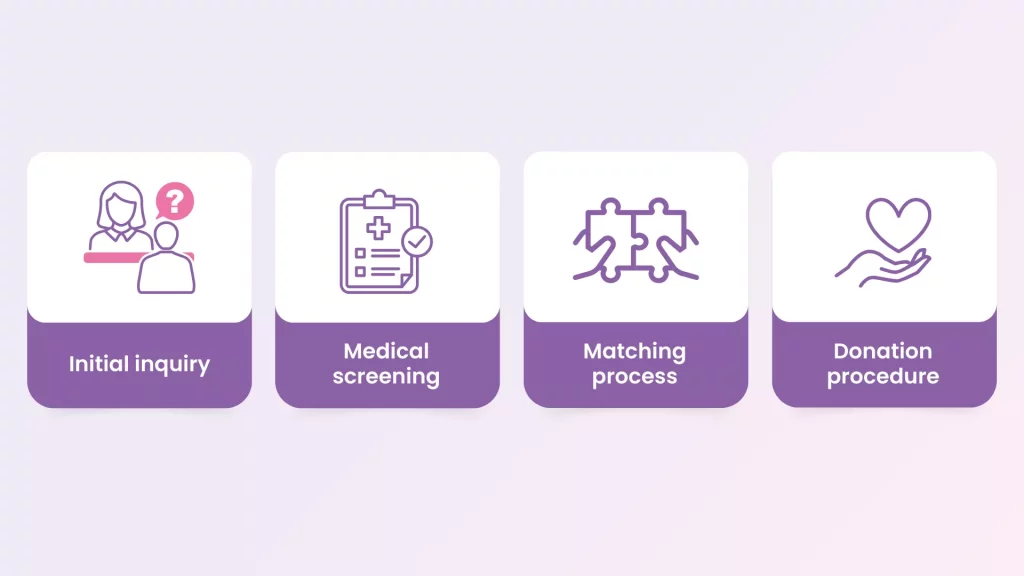
Fill out the application in about 15 minutes. Basic health history, education, and photos. No commitment is made until a match is confirmed.
A call or video review with the program team. If you pass the initial review, you move to full medical and genetic screening. All screening costs are covered.
Blood tests, AMH levels, genetic carrier screening, a physical exam, and a psychological evaluation. Lucina screens donors to FDA and ASRM standards before any match is made.
Once matched, hormone injections begin. Monitoring appointments, blood draws and ultrasounds, happen every few days at a fertility clinic near you.
A 20–30 minute outpatient procedure under light sedation. You’ll need a driver home. Travel and accommodation are covered when retrieval is outside your area. Read more about the egg retrieval process.
Payment is processed after the retrieval is complete, typically within a few weeks. Medical and travel reimbursements are handled separately throughout the process.
Applying to Lucina From Anywhere in the U.S.
We’re a frozen egg bank headquartered in San Diego, California, with active donors across every U.S. state. Our bank holds 3,500+ screened donor profiles, making it one of the largest egg banks in the country.
The application is available online and takes about 15 minutes to complete. There’s no commitment at the application stage. If you pass the initial review, a coordinator contacts you within two weeks. Screening and medical evaluation happen after that, at a pace that fits your schedule. You can review the full become an egg donor page for program specifics before submitting.
If you graduated from or currently attend a top-ranked university, you may qualify for the Iconic donor program. Iconic donors are not listed in the public gallery. They’re recruited through a private matching process that starts at higher per-cycle rates and scales with additional completed cycles.
Ready to Find Out If You Qualify
The research phase has a stopping point. At some point, the eligibility screening is what tells you where you stand, and that requires submitting an application. Reading more comparison articles won’t answer questions the medical review will.
A few pages worth reviewing before you apply: the pros and cons of donating eggs, what recovery after retrieval looks like, and our specific egg donor requirements. Those three cover most questions that come up before a first call.
Egg donation near you doesn’t require a local program. It requires one that pays fairly, communicates clearly, and runs to clinical standard. If you’re 19–31 and want to know where you stand, the Lucina application takes 15 minutes and you’ll hear back within two weeks.
Apply to Donate Eggs With Lucina
Donors from every U.S. state are welcome to apply. Monitoring appointments work with a local clinic near you, and all travel for egg retrieval is covered by Lucina.
$8,000–$15,000+ per cycle (Standard) · Up to $50,000 per cycle (Iconic) · 6–10 week process
All medical and travel costs covered. Compensation paid after retrieval. Up to 6 donation cycles allowed per ASRM lifetime guidelines.
Frequently Asked Questions

Julianna Nikolic
Chief Strategy Officer Julianna Nikolic leads strategic initiatives, focusing on growth, innovation, and patient-centered solutions in the reproductive sciences sector. With 26+ years of management experience and a strong entrepreneurial background, she brings deep expertise to advancing reproductive healthcare.

Table of Contents
- You Don't Need a Local Egg Donation Center
- What Egg Donation Programs Near You Actually Pay
- What to Look for in an Egg Donation Program Near You
- Requirements to Donate Eggs Near Me
- How the Egg Donation Process Works
- Applying to Lucina From Anywhere in the U.S.
- Ready to Find Out If You Qualify
- Frequently Asked Questions