
The pros and cons of donating eggs look different depending on where you are in the decision. If you’re exploring for the first time, the financial upside is usually what gets your attention. If you’ve done more reading, the questions tend to shift: What do the injections feel like? How many appointments does it actually require? Are there long-term effects on your fertility?
This article covers both sides honestly: the benefits donors consistently report, the trade-offs worth knowing, the financial reality, and the questions most people work through before they apply.
Whether egg donation turns out to be the right fit or not, this is a decision that deserves a complete picture first.

Pros and Cons of Donating Eggs: The Overview
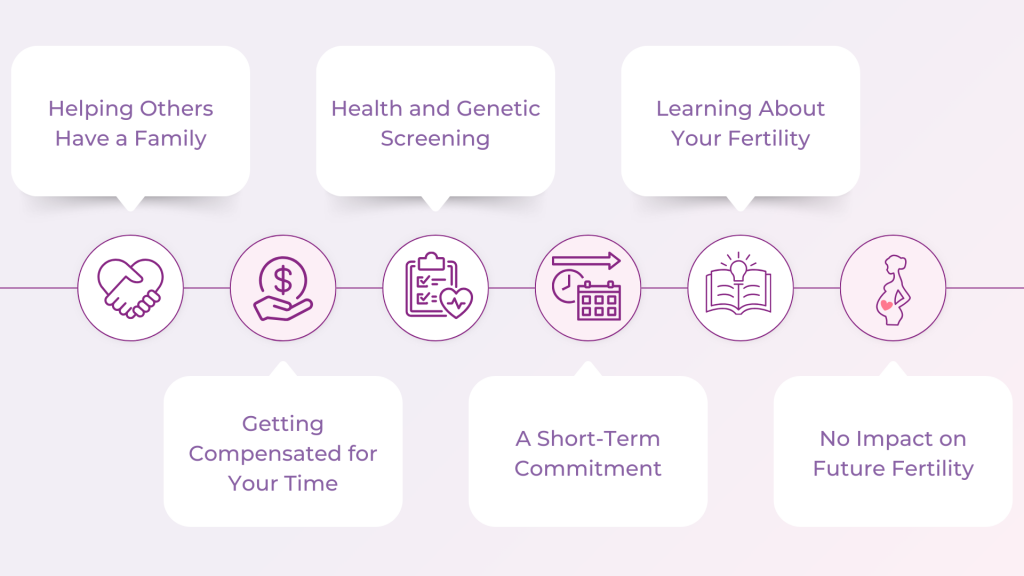
What are the pros and cons of donating eggs? The main pros are financial compensation ($8,000–$50,000+ per cycle), helping a family conceive, free full health screening, and no lasting impact on personal fertility. The main cons are temporary side effects during hormonal stimulation, a time commitment of 5 to 7 monitoring appointments per cycle, and long-term privacy considerations in the era of consumer genetic testing. Most donors describe the experience as more manageable than they expected.
The Pros of Donating Eggs
Financial Compensation
Standard donors at Lucina Egg Bank earn $8,000–$15,000+ per cycle. Donors who attend or graduated from a top-ranked university may qualify for the Iconic tier, which pays up to $50,000 per cycle. All medical appointments, travel costs, and procedures are covered separately. The compensation is take-home pay.
Donors can complete up to 6 cycles over their lifetime under American Society for Reproductive Medicine (ASRM) guidelines. That means a cumulative maximum of $90,000 for Standard donors or $300,000 for Iconic donors. How much egg donors make depends on tier, profile, and number of completed cycles.
Helping Others Start a Family
For most intended parents who use donor eggs, it’s the only realistic path to parenthood. Some have spent years cycling through failed IVF attempts. Others have medical conditions that have depleted their own egg supply. A donor’s contribution isn’t a supplement to other options. For many families, it’s the only option that works.
The CDC reports that approximately 1 in 5 women of reproductive age in the United States have difficulty getting pregnant or carrying a pregnancy to term. Egg donation represents a direct path to parenthood for many of these families.
Free Health and Genetic Screening
Before every donation cycle, donors undergo a medical evaluation that would cost hundreds to thousands of dollars out of pocket: genetic carrier screening for heritable conditions, ovarian reserve testing (Anti-Müllerian Hormone and Antral Follicle Count), a full infectious disease panel, and a physical exam.
For many donors, this is the first time they’ve had a detailed look at their reproductive health. AMH and AFC results tell you things about your fertility that standard annual checkups don’t measure. All of it is provided at no cost to the donor as part of standard egg donor screening.
No Effect on Your Future Fertility
This concern comes up consistently, and the evidence is reassuring. Egg donation retrieves eggs that would naturally be lost in the same cycle anyway. The ovaries don’t draw down a finite reserve. The monthly egg cohort that isn’t retrieved is simply reabsorbed by the body.
Research examining egg donation and future fertility has found no link between donation cycles and reduced fertility in donors. The risk level is comparable to any medical procedure involving sedation, not to anything that depletes reproductive capacity.
A Short-Term Commitment with a Clear Endpoint
Unlike surrogacy, which involves months of physical commitment and ongoing involvement, egg donation cycles last 6 to 10 weeks. Once retrieval is complete, the process ends. There are no follow-up obligations, no contact requirements, no ongoing relationship with the recipient.
This makes the timing manageable for most donors. The cycle is predictable: stimulation, monitoring, retrieval, recovery. Each stage has a defined length, which makes planning around school or work genuinely possible.
The Cons of Donating Eggs

Temporary Physical Side Effects
The stimulation phase involves daily hormone injections for 10 to 14 days. Common side effects include bloating, mild cramping, mood shifts, and fatigue. These are temporary and typically resolve within a few days of retrieval as the ovaries return to their normal size.
In rare cases, donors experience Ovarian Hyperstimulation Syndrome (OHSS), a condition where the ovaries respond more strongly than expected to stimulation. Mild OHSS is uncomfortable but self-resolving.
Severe OHSS, occurring in fewer than 2% of cycles according to published clinical data, requires medical attention. The medical team monitors hormone levels and follicle counts throughout stimulation specifically to catch and manage this early.
Knowing the difference between normal discomfort and egg donation risks that warrant clinical attention is worth reviewing before the cycle begins.
Time and Schedule Demands
The donation cycle requires 5 to 7 monitoring appointments during stimulation, each involving a blood draw and ultrasound. Most are early morning. They’re time-sensitive and can’t easily be rescheduled.
The trigger shot must be administered at a precise time exactly 36 hours before retrieval. The retrieval day itself requires taking the day off. If your schedule is unpredictable or inflexible, timing conflicts are a genuine consideration before committing to a cycle.
Emotional Effects From Hormone Changes
Stimulation injections can affect mood in ways that go beyond physical discomfort. Some donors notice heightened emotionality, irritability, or low-level anxiety during the stimulation phase. These effects are hormone-related and resolve after retrieval, but they’re worth knowing about beforehand.
Emotional changes during stimulation are part of the broader picture of typical donor body reactions.
Long-Term Privacy Considerations
Egg donations are typically anonymous, but the landscape of consumer genetic testing has changed what that means in practice. Donor-conceived individuals who use services like 23andMe or AncestryDNA can identify biological relatives, including donors, without any information from the egg bank.
This doesn’t affect most donors, but it’s a real dimension of the decision. If maintaining long-term anonymity matters to you, this is worth thinking through before applying rather than after.
Most donors say the stimulation phase was more manageable than they expected, particularly when they knew what was coming. Reading through what the physical experience involves before the cycle starts (not during it) makes a real difference in how prepared you feel.
Is Egg Donation Worth It Financially?
Whether egg donation is worth it financially depends on what you’re comparing it to. Standard donors at Lucina earn $8,000–$15,000+ per donation cycle. The 6-to-10-week cycle involves real commitment: daily injections, 5 to 7 monitoring appointments, and a recovery day.
Whether that’s worth the compensation is a personal judgment. Most donors who complete the process describe it as meeting or exceeding their expectations.
For donors who attend or graduated from a top-ranked university, the financial picture changes considerably. The Iconic program pays up to $50,000 per cycle.
The medical process is identical to the Standard cycle. The compensation difference reflects intended parent demand for donors with specific academic backgrounds. Many applicants don’t know to ask about this, and the per-cycle difference is up to $35,000.
It’s also worth noting that egg donation comes with financial benefits beyond the compensation itself: the free genetic carrier screening, AMH testing, and ovarian reserve evaluation represent diagnostics that would cost far more out of pocket. For women who want insight into their fertility at no expense, the screening component alone has real value.
If You Donate Eggs, Is the Child Biologically Yours?
Yes and no, and the distinction matters. Genetically, a child born from your donated eggs shares your DNA. Your egg contains half the genetic material that makes that child who they are. In that sense, you are biologically related to any children born from your donation.
Legally, no. As part of the donation agreement, you relinquish all parental rights and responsibilities. The intended parents are the legal parents from the moment of conception. You have no legal claim to, or financial responsibility for, any children born from your eggs.
The psychological evaluation that’s part of donor screening is designed specifically to confirm you’ve thought through this distinction and are comfortable with it before the cycle begins. Most donors who complete the process have worked through the question thoroughly by the time of their first cycle and describe it as settled rather than lingering.
Curious If You Qualify?
Eligibility depends on age (19–31), ovarian reserve, and general health. The pre-screen takes about a minute and gives you a clear starting point.
Check the BasicsShould I Donate My Eggs? Six Questions to Work Through
Most uncertainty about egg donation comes from not knowing the specifics. Working through these six questions moves the decision from abstract to concrete.
Lucina’s donor age range is 19–31. If you’re approaching 30 and have been considering this for a while, applying sooner gives you more cycles and more total compensation potential. The full donor requirements list every criterion.
The stimulation phase requires 5 to 7 early-morning appointments over 10 to 14 days. The trigger shot must be given at a precise time. The retrieval day requires a full day off. If your schedule allows for this kind of structured commitment, the logistics are manageable.
The cycle involves daily self-administered injections during stimulation and a 20-to-30-minute outpatient retrieval under sedation. The egg retrieval process is covered in full if you want the clinical detail before deciding.
Your donated eggs share your DNA. Any children born are legally the intended parents’ children, not yours. The genetic connection is real. Most donors work through this before their first cycle and find it settled. The psychological evaluation confirms you’ve done so.
Financial, altruistic, or both: all are valid. What matters is that your motivation is genuine and that you’re going in with realistic expectations rather than uncertainty about why you’re doing it. The psychological evaluation will ask directly, and clear answers make the process faster.
Standard donors earn $8,000–$15,000+ per cycle. Donors from top-ranked universities may qualify for the Iconic tier at up to $50,000 per cycle. Many applicants don’t raise their education background, and the compensation gap is large. Mention it on your application if it applies.
The six questions above are a starting point. A donor application takes about 15 minutes and answers most remaining questions concretely.
What to Do If You’re Ready to Find Out
The pros and cons of donating eggs don’t resolve into a simple answer for everyone. They depend on your schedule, your health, your financial situation, and how you feel about the genetic dimension of donation.
Most donors say the decision became clearer once they understood the process fully, not from reading more abstractly but from seeing the actual schedule, the actual compensation, and the actual screening criteria. Uncertainty tends to compress into specific, answerable questions once you have those details.
The application takes about 15 minutes. If you’d like more context on what sets Lucina apart before applying, why donors choose Lucina covers the details.
Apply to Donate Eggs With Lucina
Egg donation is a short-term commitment with compensation, free health screening, and a clear endpoint. If the pros and cons seem worth exploring, the fastest way to know if you qualify is to apply.
$8,000–$15,000+ per cycle (Standard) · Up to $50,000 per cycle (Iconic) · 3,500+ screened donors
All medical and travel costs covered. Compensation paid after retrieval. Up to 6 donation cycles allowed per ASRM lifetime guidelines.
Frequently Asked Questions

Julianna Nikolic
Chief Strategy Officer Julianna Nikolic leads strategic initiatives, focusing on growth, innovation, and patient-centered solutions in the reproductive sciences sector. With 26+ years of management experience and a strong entrepreneurial background, she brings deep expertise to advancing reproductive healthcare.

Table of Contents
- Pros and Cons of Donating Eggs: The Overview
- The Pros of Donating Eggs
- The Cons of Donating Eggs
- Is Egg Donation Worth It Financially?
- If You Donate Eggs, Is the Child Biologically Yours?
- Should I Donate My Eggs? Six Questions to Work Through
- What to Do If You're Ready to Find Out
- Frequently Asked Questions