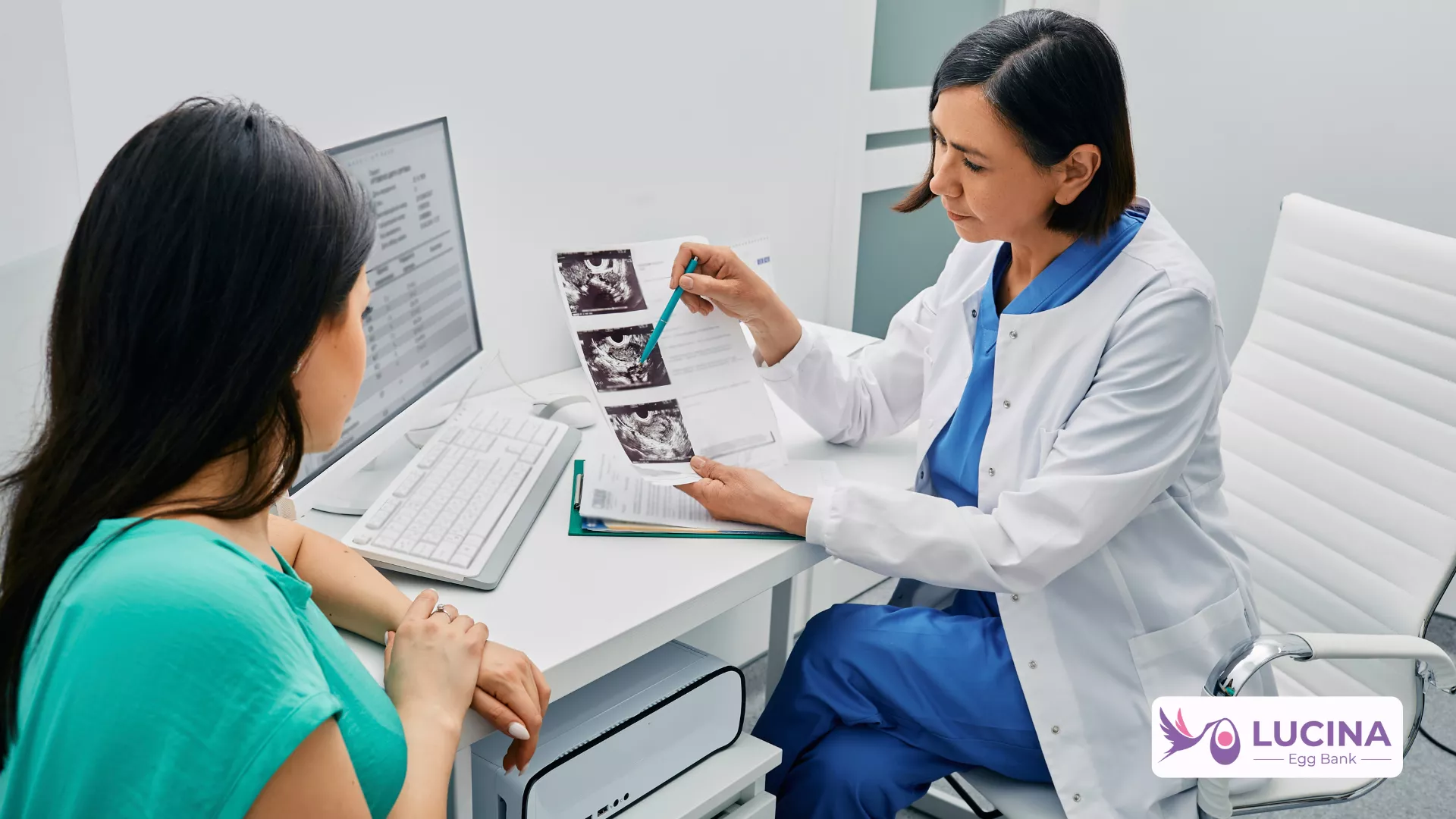

The money is real. So is the question underneath it: what does egg donation actually do to your body? Most programs walk you through the steps. Far fewer give a straight answer about egg donation side effects, what’s temporary, what’s rare, and what the research says about long-term safety.
This article breaks it down honestly. Short-term side effects during stimulation and retrieval are common and, for most donors, manageable. The long-term picture is more reassuring than online forums suggest, though the donor-specific data has real limits worth knowing about.
At Lucina Egg Bank, we screen donors carefully and cover all medical costs from day one. If anything unexpected comes up during your cycle, we handle it. The decision is still yours, and it should be an informed one.
Short-Term Egg Donation Side Effects
Short-term egg donation side effects cluster in two windows: the stimulation phase (roughly 10 to 14 days of hormone injections before retrieval) and the retrieval procedure itself. Most are predictable, manageable, and temporary.
During Stimulation
Ovarian stimulation medications tell your ovaries to mature multiple eggs at once. Your ovaries work harder than usual, and your body responds to elevated hormone levels. Common side effects during this phase include the following.
- Bloating. Your ovaries enlarge as follicles develop. This can feel like real abdominal fullness or pressure, especially toward the end of the stimulation phase.
- Mood swings. Elevated estrogen and progesterone affect neurotransmitter activity. Emotional sensitivity, irritability, and tearfulness during stimulation are common and temporary.
- Mild bruising or soreness. Injections under the skin of the abdomen or thigh often leave small bruises. Rotating injection sites helps.
- Headaches and fatigue. Hormone shifts are the cause. These usually peak in the final days of stimulation and ease quickly after retrieval.
- Breast tenderness. Higher estrogen causes this in most donors. It resolves within a few days of retrieval.
Plan around the stimulation phase. Most donors work, study, and keep normal routines throughout. The final few days before retrieval tend to be the most physically uncomfortable, so keeping those days light is smart planning, not a requirement.
The Retrieval Procedure
Egg retrieval is an outpatient procedure that takes about 20 to 30 minutes. You’ll be under light sedation, so you won’t feel it happening. What you’ll notice is the recovery afterward.
Most donors feel cramping and pelvic soreness after retrieval, similar to period cramps. Spotting is normal. Fatigue on retrieval day is common. Most donors feel back to themselves within two to five days, and a small number take a full week.
The egg retrieval process is well documented, and your care team will walk you through post-retrieval instructions for rest, activity, and what to watch for. Follow them, since they exist for a reason.
Ovarian Hyperstimulation Syndrome (OHSS) and AMH
OHSS is the most serious short-term risk of egg donation. It happens when the ovaries over-respond to stimulation medication, produce too many follicles, and cause fluid to build up in the abdomen.
Most cases are mild. Symptoms include bloating, abdominal discomfort, nausea, and minor weight gain from fluid. Mild OHSS resolves on its own within one to two weeks of retrieval.
Moderate OHSS brings more swelling, reduced urination, and stronger discomfort. It’s manageable and usually resolves without hospitalization. Severe OHSS is less common.
The ASRM committee opinion reports severe OHSS in about 1 to 2 percent of retrieval cycles. That rate drops further when a GnRH (gonadotropin-releasing hormone) agonist trigger replaces the traditional hCG (human chorionic gonadotropin) trigger.
The biggest predictor of OHSS risk is your ovarian reserve. A high AMH level and a high antral follicle count both signal that your ovaries may over-respond, which is exactly why screening measures them before stimulation begins.
OHSS risk is assessed during pre-donation screening. Donors with high antral follicle counts, high AMH, or low body weight are flagged before stimulation begins. Monitoring appointments during stimulation let your care team catch early signs and adjust the protocol. If you have severe or worsening abdominal pain at any point, contact your medical team right away.
Long-Term Egg Donation Side Effects: What the Research Says
Here’s the question most donors actually want answered: will egg donation affect my fertility, my hormones, or my health years from now? The honest answer is that current evidence is reassuring, but the research on donors specifically is still thin.
Does Egg Donation Affect Your Future Fertility?
Current research does not show that egg donation reduces a donor’s future fertility. You’re born with roughly 1 to 2 million eggs. The eggs retrieved during a donation cycle come from the group your body would have lost naturally that month, so they aren’t taken from your long-term reserve.
Your ovaries recruit a group of follicles each menstrual cycle. Normally one matures and ovulates while the rest are reabsorbed. Stimulation medication lets more of that same group mature instead of disappearing. The retrieved eggs were already on their way out.
A review in Fertility and Sterility by Columbia University researchers found little evidence either supports or rules out long-term fertility concerns. Serious complications from donation appear rare, occurring in fewer than 1 percent of cases.
ASRM’s committee opinion notes available data doesn’t suggest donation changes a donor’s ovarian reserve, while calling for more long-term follow-up on repeat donors.
Donors who complete their cycles return to normal menstrual function, usually within four to six weeks. If you have specific concerns about your own fertility history, talking with a reproductive endocrinologist before applying is a reasonable step.
Does Egg Donation Cause Early Menopause?
No, current evidence does not link egg donation with early menopause in healthy donors. This fear shows up constantly in donor forums, and it’s understandable, since ovarian stimulation sounds intense. The data, though, doesn’t connect donation to premature ovarian insufficiency.
Premature ovarian insufficiency has its own established risk factors: genetics, autoimmune conditions, and certain medical treatments like chemotherapy. Egg donation stimulation protocols don’t fall into that category for otherwise healthy women.
The 6-cycle lifetime limit is a precautionary standard, not a sign that more cycles would be harmful. ASRM’s committee opinion describes an absence of definitive long-term follow-up data rather than evidence of harm, and still backs the cap because procedural risk is cumulative and multi-year donor data is scarce.
Does Egg Donation Increase Cancer Risk?
This concern has been studied closely, and the picture is mostly reassuring, with one nuance worth knowing.
ASRM’s 2024 fertility drugs guideline found no evidence of increased risk for breast, colon, or cervical cancer from fertility treatment. Ovarian cancer is more complex.
There’s weak-to-moderate evidence of a small increase, about 3 extra cases per 100,000 person-years. ASRM notes it’s hard to tell if that reflects the drugs or underlying factors like endometriosis or never having given birth, both already tied to higher ovarian cancer risk.
One study of oocyte donors, the population most relevant to donor safety, found no ovarian or uterine cancer cases and only one breast cancer case over an average follow-up of more than 11 years. ASRM described the results as reassuring for ovarian cancer risk in oocyte donors, while noting larger studies are needed.
A large U.S. case-control study found fertility drug use doesn’t meaningfully add to overall ovarian cancer risk once known confounders are accounted for. The distinction matters: the elevated risk seen in some studies tracks with infertility itself, not the medication, and egg donors are by definition fertile.
If you have a personal or family history of hormone-sensitive cancers, share it during pre-donation screening. It may or may not affect your eligibility, but the medical team needs to know.
Repeat Donation and Spacing Between Cycles
The risk of repeat donation is cumulative, not sudden, which is why spacing between cycles matters. ASRM’s guidance pairs the 6-cycle lifetime cap with enough recovery time between retrievals for your ovaries and hormone levels to return to baseline.
In practice, that means waiting until your cycle normalizes, typically a few months, before starting another stimulation. Back-to-back cycles with too little recovery raise the odds of side effects without changing the lifetime limit. Our team schedules repeat donations with that recovery window built in.
Hormonal and Emotional Recovery After Donation
After retrieval, hormone levels drop sharply as your body returns to its normal cycle. For most donors this is physically uneventful. For some, the shift causes a brief emotional low, similar to premenstrual symptoms but sometimes more pronounced.
This usually resolves within one to two weeks. If you notice persistent mood changes, cycles that don’t normalize within four to six weeks, or anything that doesn’t feel right, contact your care team. Lingering symptoms aren’t something to push through quietly.
Mental health history is reviewed during Lucina’s egg donor screening process, not as a gatekeeping measure but because donation carries real emotional weight. If you’ve wondered if a history of depression rules you out, it often doesn’t on its own, though the team needs the full picture. That support doesn’t disappear after retrieval day.
What Screening Does Before You Start
Much of the safety in egg donation comes from what happens before any medication is prescribed. Screening exists to catch contraindications early, before they turn into mid-cycle problems.
Our process is built around ASRM compliance and Food and Drug Administration (FDA) requirements for donor tissue. It includes a full medical evaluation, genetic testing for 200+ conditions, psychological assessment, and an ovarian reserve check (AMH and antral follicle count).
If anything in your profile raises a concern, the team addresses it before stimulation starts. The full donor requirements spell out what disqualifies and what doesn’t.
Health history, medications, lifestyle factors, and family medical history are reviewed before you’re invited to the next phase.
Blood work, hormone panels (AMH and follicle-stimulating hormone, FSH), ultrasound, and a physical exam. This is where ovarian reserve and OHSS risk factors are assessed.
Carrier status for 200+ inheritable conditions is screened. This protects both your health profile and the integrity of the donation.
A licensed mental health professional reviews your readiness, motivations, and any factors that could affect your experience or wellbeing.
Side Effects That Require Immediate Attention
Most egg donation side effects are mild and expected. A few symptoms warrant a call to your care team right away. Don’t wait to see if they improve on their own.
- Severe abdominal pain or swelling. Worsening abdominal pain after retrieval is not normal discomfort. It can signal complications including severe OHSS or, very rarely, ovarian torsion.
- Difficulty breathing. In rare cases of severe OHSS, fluid collects in the chest cavity. Shortness of breath after retrieval needs immediate evaluation.
- Heavy bleeding. Light spotting after retrieval is expected. Heavy bleeding or clots are not.
- Signs of infection. Fever, increasing pelvic pain, or unusual discharge more than 24 hours after retrieval should be reported to your care team.
- Cycles that don’t return. If your period doesn’t resume within six to eight weeks of retrieval, follow up with your medical team.
These situations are uncommon. Knowing them in advance means you’re not guessing if something warrants a call.
What Most Donors Actually Experience
The clinical picture and the lived experience don’t always match. Here’s what donors commonly describe, beyond the medical framing.
The stimulation phase is the hardest part. Injections are manageable but not fun. Bloating in the final days before retrieval can be real. Retrieval day itself is easier than most donors expect, since sedation takes away the fear and the procedure is brief.
The week after retrieval varies. Some donors feel fine within two days. Others need a full week. Most return to exercise within two weeks, sometimes sooner, depending on recovery and medical clearance.
The emotional piece deserves a direct mention. Some donors feel a sense of loss after retrieval, even when they felt confident going in. That’s common, and it doesn’t mean the decision was wrong. Lining up someone to talk to, a friend, partner, or counselor, is worth planning before retrieval day, not after.
For more on the pros and cons, or what may disqualify you from donating, we cover both in detail elsewhere.
Weigh the Egg Donation Side Effects Before You Decide
Egg donation is a real medical commitment. The compensation is meaningful, and so is the physical process. Both are true, and you’re better off knowing that going in.
Short-term egg donation side effects are real but temporary. Long-term risks, based on current evidence, are low for healthy donors who go through rigorous screening. The 6-cycle limit stands as a precautionary standard while long-term follow-up data keeps developing, and honest science says what it doesn’t yet know. If the numbers reassure you, here’s how egg donation works at Lucina.
Apply to Donate Eggs With Lucina
We cover every medical cost, every monitoring appointment, and all travel, so the side-effect question is never one you face alone. If you want to talk through your own health situation first, our coordinators answer directly and the application is free.
$8,000–$15,000+ per cycle (Standard) · Up to $50,000 per cycle (Iconic) · 1–3 day typical recovery
All medical and travel costs covered. Compensation paid after retrieval. Up to 6 donation cycles allowed per ASRM lifetime guidelines.
Frequently Asked Questions

Julianna Nikolic
Chief Strategy Officer Julianna Nikolic leads strategic initiatives, focusing on growth, innovation, and patient-centered solutions in the reproductive sciences sector. With 26+ years of management experience and a strong entrepreneurial background, she brings deep expertise to advancing reproductive healthcare.