How Old Do You Have to Be to Donate Eggs? Age Requirements for Egg Donation

If you’re thinking about becoming an egg donor, one of the first questions you’ll naturally ask is: how old do you have to be to donate eggs?
Well, the short answer is, here at Lucina Egg Bank, egg donor age requirements are usually 18 to 31 years old. If you’re younger than 18, you’ll need to wait. If you’re older than 31, egg donation is usually no longer an option.
From there, things get a bit more nuanced. After all, age connects to egg quality, success rates for Intended Parents, and your own physical and emotional readiness.
So, without further ado, let’s talk about how old you have to be to donate eggs, the “golden window” for donation, why legal adulthood doesn’t always match medical eligibility, and how clinics verify your age.
What Age Do You Have to Be to Donate Eggs?
As mentioned above, most egg donation programs, including Lucina Egg Bank, accept donors who are roughly 18–31 years old.
Inside that window, your ovaries usually respond well to medication, and your eggs have a higher chance of leading to healthy pregnancies. Outside that range, success rates drop and risks can increase.
For Lucina Egg Bank in particular:
- Minimum age to donate eggs: 18
- Maximum age for egg donors: 31
If you’re already in this age range, you can usually move straight to the application and screening stage.
If you’re younger than 19 or older than 31, egg donation at Lucina Egg Bank probably will not be an option, but you may still be able to support intended parents in other ways.
Legal Age vs. Clinic Age: Why They Don’t Always Match
A common confusion is this:
“If I’m a legal adult at 18, why can’t I donate eggs yet?”
Legally, 18 is the age of adulthood in many countries. But egg donation age requirements are not just about legal adulthood—they’re also about medical guidelines and psychological readiness.
In practice:
- 18 – You may be a legal adult, but many clinics still consider you too young for egg donation.
- 19–20 – A “grey zone” where some programs (like Lucina) may start screening, while others still prefer to wait.
- 21–29 – The most common clinic age range and often the “gold standard” for donor programs.
The age you can donate eggs from a legal standpoint is not always the age at which clinics feel comfortable inviting you into a medical process with long-term implications.
Why Do Egg Donor Age Requirements Exist?

Now, here’s another question: in the first place, why do egg donor age requirements even exist?
Egg donor age requirements exist because age strongly affects egg quality, success rates, and safety for you as the donor.
Across multiple fertility studies, doctors see the same pattern:
- Eggs from people in their late teens through their twenties tend to have higher “euploid” rates (normal chromosome counts).
- As age climbs into the thirties, the chance of aneuploidy (abnormal chromosomes) rises, which can mean fewer healthy embryos and more failed transfers or miscarriages.
Age also affects:
- How your ovaries respond to medication. Younger donors usually respond more predictably.
- How many eggs can be retrieved safely. Within the donor age range, doctors can often retrieve a good number of eggs with moderate medication doses.
- Physical and emotional resilience. Donors in their late teens and twenties usually recover faster from stimulation and retrieval and may find it easier to manage the schedule.
So when you see a specific egg donor age limit on a website, it isn’t meant as a judgment. It’s there to protect you and to give Intended Parents a realistic chance of building their family.
We’ll explore the deeper “why” behind age requirements in a separate article on why there is a minimum age for egg donors. For now, the important thing is this: age is one of the strongest predictors of how well egg donation will work.
Is There a “Best” Age to Donate Eggs?
The best age to donate eggs is usually within your mid-twenties—roughly 24 to 27.
In that band, many donors:
- Have well-established cycles
- Have had some adult life experience and independence
- Are still in a strong fertility window
- Can often handle the logistics around school, work, or early career
That doesn’t mean you can’t be an excellent donor at 21 or 29. It simply reflects what many clinics observe when they look at outcomes, schedules, and overall readiness.
If you’re asking, “What’s the best age to donate eggs?” and you’re somewhere in your mid-twenties, you’re likely in a very favorable position from an age standpoint.
How Do Egg Donation Age Requirements Work at Lucina Egg Bank?
At Lucina, age is one of the first screening questions, but never the only one.
To move forward as a donor, you’ll typically need to:
- Be between 19 and 31 years old
- Have regular menstrual cycles when you’re not on strong hormonal suppression
- Meet BMI, health, and lifestyle guidelines
- Provide medical history for at least three generations of your family
- Be able to commit to appointments and medication schedules
Once you submit an application, the team reviews your age alongside your general health, cycle history, and other factors. If you fit the egg donation age requirements but something else raises questions, you may still be turned down for safety reasons.
On the other hand, if you are on the edge of the age range but have excellent ovarian reserve and strong overall health, you may still be accepted.
How Does Age Fit Into the Rest of the Screening?
Age opens the door, but it does not guarantee acceptance.
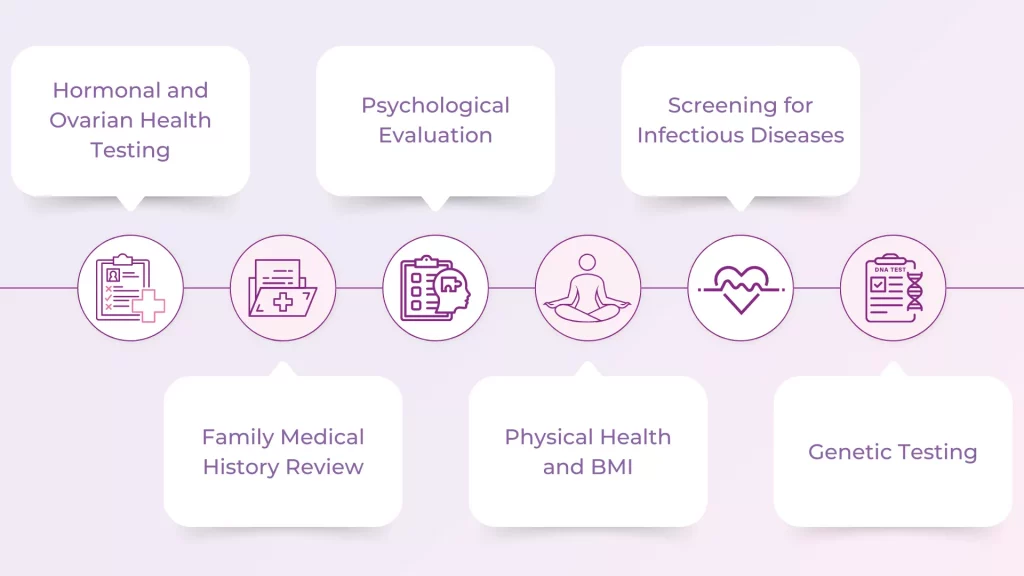
Even if you meet the egg donor age requirements, you still need to pass the general egg donor requirements:
- Hormone and ovarian reserve testing. Doctors look at indicators like AMH to see how your ovaries are functioning for your age.
- Physical exam and lab work. To confirm that your body can handle stimulation and retrieval.
- Family history review. To check for inherited conditions that might affect donor-conceived children.
- Psychological evaluation. To talk through how you feel about donation, possible future contact, and having genetic children in the world.
If you’re 18-31 and in generally good health, age gives you a strong starting point. From there, screening confirms if egg donation fits you medically and emotionally.
So even if you’re asking, “Can I donate eggs at 20?” or “Am I too old at 30?”, the full answer always includes these other factors as well.
How Do Clinics Verify Your Age?
Clinics don’t just take your word for it – they verify your age formally.
At Lucina Egg Bank, it looks like:
- Initial application. You enter your date of birth so we can see, early on, if you fit the age window.
- Screening step. Before moving forward, you’re asked to provide government-issued ID (like a driver’s license or passport).
- Compliance check. This helps us stay aligned with FDA guidelines and professional recommendations, and protects everyone involved.
This may seem like a minor detail, but it’s part of how we keep the process safe and transparent.
Quick Check: Are You at the Right Age to Donate Eggs Right Now?
Use this quick self-check to see if age might be on your side:
- I am at least 18 years old.
- I am 31 or younger.
- I understand that 21–29 is often considered the “golden window” for donors.
- If I’m 20 or younger, I know I may face extra review or be asked to wait.
- If I’m close to 31, I’m ready to move forward soon if I decide to apply.
If you can say “yes” to most of those, age is probably not your main obstacle. From here, the questions become:
- Does egg donation fit my health?
- Does it fit my schedule?
- Am I emotionally comfortable with the idea of having genetic children I may never meet?
The next step is to apply and let the medical team look at the full picture.
Ready to Find Out If Your Age Fits Lucina’s Egg Donor Requirements?
Age is one of the simplest questions in egg donation—and also one of the most important. Egg donor age requirements protect your health, improve success rates for intended parents, and give everyone a clearer sense of what to expect.
If you:
- Are between 18 and 31, and
- Feel ready to learn more about the process
…then you may be at a great point in life to consider egg donation.
At Lucina Egg Bank, we’re here to talk through your questions honestly, from how old you have to be to donate eggs, to what the age limit for egg donors looks like, to why a minimum age exists in the first place.
You don’t have to have everything figured out on your own. Your job is to be honest about your age and your situation. Our job is to tell you clearly if you fit the current egg donor age requirements – and if you do, to support you through the rest of the journey.

Julianna Nikolic
Chief Strategy Officer Julianna Nikolic leads strategic initiatives, focusing on growth, innovation, and patient-centered solutions in the reproductive sciences sector. With 26+ years of management experience and a strong entrepreneurial background, she brings deep expertise to advancing reproductive healthcare.

Table of Contents
- What Age Do You Have to Be to Donate Eggs?
- Legal Age vs. Clinic Age: Why They Don’t Always Match
- Why Do Egg Donor Age Requirements Exist?
- Is There a “Best” Age to Donate Eggs?
- How Do Egg Donation Age Requirements Work at Lucina Egg Bank?
- How Does Age Fit Into the Rest of the Screening?
- How Do Clinics Verify Your Age?
- Quick Check: Are You at the Right Age to Donate Eggs Right Now?
- Ready to Find Out If Your Age Fits Lucina’s Egg Donor Requirements?