

A lot of women with tubal ligation assume egg donation is off the table. It’s an understandable assumption. But it’s wrong, and the reason why tells you something important about how egg retrieval actually works.
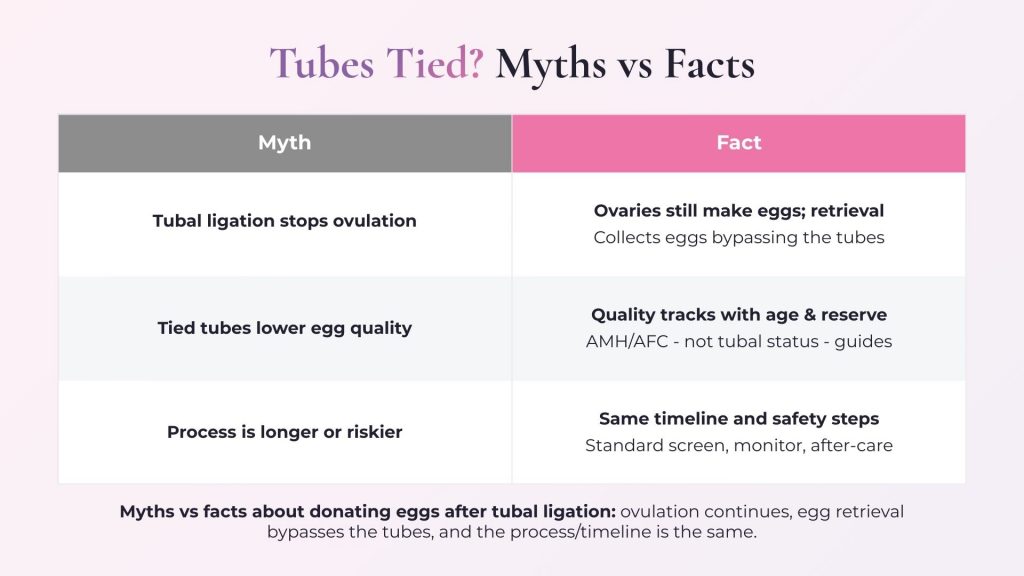
Tubal ligation blocks the fallopian tubes. Egg retrieval bypasses them completely. The two procedures don’t interact at all.
Your ovaries keep producing eggs after a tubal ligation exactly as they did before. Those eggs are collected directly from the ovaries during donation, with the fallopian tubes not involved at any point.
So: can you donate eggs if your tubes are tied? In most cases, yes. What actually determines eligibility is your ovarian reserve, your age, your general health, and whether you pass standard screening. Not your surgical history.
What Tubal Ligation Does (and Doesn’t Do)
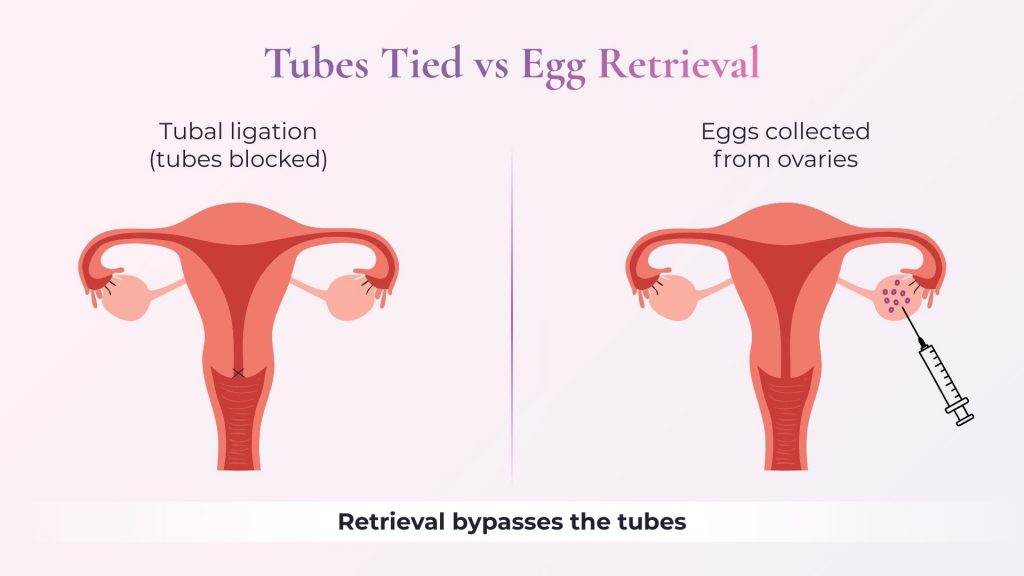
Tubal ligation is a permanent contraceptive procedure that seals or blocks the fallopian tubes. The name is slightly misleading — the tubes aren’t literally tied. They’re cut, clamped, banded, or sealed with heat, depending on the technique used.
The goal is to stop sperm from reaching an egg and stop a fertilized egg from reaching the uterus. It works because fertilization normally happens inside the fallopian tubes. Block the tubes, and natural conception becomes unlikely.
What tubal ligation does not do is touch your ovaries. Your ovaries continue producing hormones, recruiting follicles, and releasing eggs on their normal cycle after the procedure, exactly as they did before. The eggs just have nowhere to go naturally.
Does Tubal Ligation Affect Your Eggs?
No. Tubal ligation changes the route eggs travel. It does not change the eggs themselves. Egg quality is determined by age, genetics, and ovarian reserve, none of which are affected by the procedure. Research confirms that tubal ligation does not reduce ovarian reserve markers or alter hormonal cycling.
Two markers tell clinics everything they need to know about your eggs before approving a donation cycle.
- Anti-Müllerian Hormone (AMH). A blood test that reflects your remaining egg supply. Results come back quickly and give clinicians a reliable snapshot of your ovarian reserve.
- Antral Follicle Count (AFC). A brief transvaginal ultrasound that counts the small resting follicles visible in each ovary. The count correlates closely with how many eggs stimulation is likely to produce.
Neither test is affected by the status of your fallopian tubes. If your AMH and AFC are within range, your tubal ligation history is medically irrelevant to your candidacy.
Can You Donate Eggs If Your Tubes Are Tied?
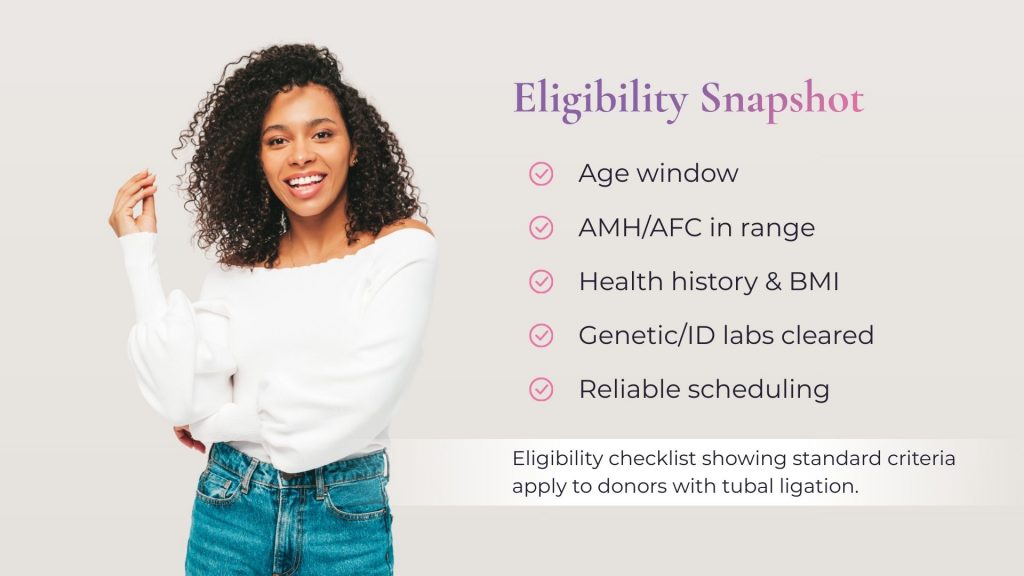
Yes, in most cases. The standard donor eligibility criteria apply the same way they do for any applicant. Tubal ligation doesn’t add a disqualifier and doesn’t require special exceptions.
Here’s what actually determines whether you qualify.
- Age. Lucina’s donor age range is 19–31.
- Ovarian reserve. AMH and AFC results within acceptable ranges for stimulation.
- General health. Body mass index (BMI), no current smoking, and passing a basic health history review.
- Genetic screening. Standard carrier screening for heritable conditions.
- Infectious disease labs. FDA-required testing completed before any cycle.
- Psychological evaluation. A brief screen to confirm informed consent and emotional readiness.
One practical note: tell your coordinator the type and date of your tubal ligation, and bring any surgical records you have. It helps the medical team build an accurate picture of your pelvic history, which makes the screening process faster, not harder.
Lucina’s pre-screen takes about a minute. It confirms the basics and gives you a clear next step. No commitment required to check.
Apply as a DonorHow Egg Retrieval Works When Your Tubes Are Tied
The retrieval procedure is the same regardless of tubal ligation status. Understanding why clarifies why the surgery is irrelevant.
During a standard retrieval, the doctor inserts a thin needle through the vaginal wall using real-time ultrasound guidance. The needle reaches each mature follicle in the ovary and aspirates the fluid inside, which contains the egg. The entire procedure takes 20 to 30 minutes under light sedation.
The fallopian tubes are not accessed, not visible in the operative field, and not relevant to the procedure at any point. Whether they’re open, blocked, or removed entirely makes no difference to how retrieval is performed or how many eggs are collected.
In rare cases where a donor has a history of pelvic surgery that caused significant scarring or adhesions around the ovaries, the medical team may note this during screening. This is not specific to tubal ligation, and it’s assessed individually. For the vast majority of donors with tied tubes, retrieval proceeds without any modification to the standard protocol.
The Egg Donation Process, Step by Step
The full donation process runs 6 to 10 weeks from application to recovery. The active medical phase is much shorter. Here’s what each stage looks like.
Share your health and surgical history, including your tubal ligation. A coordinator walks through your timeline, answers questions, and explains compensation. Mention your surgical type and date here if you have it.
AMH blood test and AFC ultrasound to check ovarian reserve. Standard genetic and infectious-disease labs. A brief psychological screen for informed consent. No additional tests are required solely because of your tubal ligation history.
Daily self-administered follicle-stimulating hormone (FSH) injections at home. Five to seven short check-in appointments for blood draws and ultrasounds. Mild bloating toward the end of stimulation is common and expected.
Outpatient procedure, 20 to 30 minutes, under light sedation. Eggs are collected directly from the ovaries. Most donors rest the day of retrieval and return to normal activity within 1 to 2 days. Heavy lifting is off-limits until cleared.
For a full walkthrough of timing and what to expect at each appointment, the egg retrieval process guide covers it in detail.
How Tubal Ligation Can Actually Simplify Donation
Most donors with tubal ligation find the process slightly simpler than those managing hormonal contraception. A few specific reasons why.
- Faster to cycle-ready. There’s no hormonal birth control to stop or wash out before stimulation can begin. You can move from screening to scheduling sooner.
- Cleaner stimulation protocol. Tubal ligation does not affect ovarian hormone levels, so the stimulation protocol doesn’t need to account for residual hormonal effects from prior contraception.
- Verified pelvic history on file. Operative notes from your ligation give the medical team a clear, documented view of your anatomy. That’s more useful than a verbal history alone.
- Contraception management between cycles is simpler. Donors who complete multiple cycles don’t need to manage starting and stopping temporary birth control between donations.
- Built-in contraceptive certainty during stimulation. Temporary elevation of fertility after retrieval is a known effect of hormonal stimulation. With tubal ligation in place, that’s already managed.
These aren’t guarantees of a smoother experience. Every donor’s cycle is individual. But for many women with tubal ligation, the practical logistics around contraception are simply one less variable to manage.
What to Tell Your Coordinator
When you apply, disclose your tubal ligation upfront. It’s not a red flag. It’s useful context that helps your medical team plan efficiently. Here’s what to have ready.
- Type of procedure. Whether tubes were cut, clamped, banded, or sealed, and whether it was done laparoscopically or as part of a cesarean section.
- Date of surgery. Recent procedures may prompt a brief check to confirm full healing before stimulation begins.
- Operative notes or discharge summary. Bring these if you have them. They give the medical team a verified record rather than relying on memory alone.
- Any ongoing symptoms. Pelvic pain, irregular cycles, or anything that changed after the procedure. Flag these directly, as they’re relevant to timing, not eligibility.
Read the full list of egg donation disqualifiers if you have other health history questions before applying. Tubal ligation is not on that list. If you’re still weighing the decision, the pros and cons of donating eggs and a full overview of how egg donation works are both worth reading first.
What You Earn as a Lucina Donor
Lucina covers all travel and medical costs across every cycle. Compensation depends on which tier you qualify for.
You can donate up to 6 times under American Society for Reproductive Medicine (ASRM) guidelines. All donors undergo full rescreening before each cycle. Compensation is paid per completed cycle.
Your Tubes Are Tied. Your Options Aren’t.
Tubal ligation closes one path. It doesn’t close this one. Whether you can donate eggs with your tubes tied comes down to whether you meet standard eligibility criteria, and your surgical history isn’t part of that calculation.
Your ovaries are still working. Your eggs are still there. Lucina’s team covers every medical cost, builds the schedule around your life, and keeps you informed at every step.
Compensation starts at $8,000 per cycle. The application takes about 15 minutes. If you’re curious whether you qualify, that’s the fastest way to find out.
We cover all travel and medical costs. Compensation starts at $8,000 per cycle, with higher pay for donors from top-ranked universities. The application takes about 15 minutes.
Apply as a DonorFrequently Asked Questions

Julianna Nikolic
Chief Strategy Officer Julianna Nikolic leads strategic initiatives, focusing on growth, innovation, and patient-centered solutions in the reproductive sciences sector. With 26+ years of management experience and a strong entrepreneurial background, she brings deep expertise to advancing reproductive healthcare.

Table of Contents
- What Tubal Ligation Does (and Doesn't Do)
- Does Tubal Ligation Affect Your Eggs?
- Can You Donate Eggs If Your Tubes Are Tied?
- How Egg Retrieval Works When Your Tubes Are Tied
- The Egg Donation Process, Step by Step
- How Tubal Ligation Can Actually Simplify Donation
- What to Tell Your Coordinator
- What You Earn as a Lucina Donor
- Your Tubes Are Tied. Your Options Aren't.
- Frequently Asked Questions